
The 2015 title The Escapists put players in charge of daring prison breaks, having them weave complex plans of escape while under the eyes of watchful guards. By concealing their actions, making the right friends in jail, and carefully going through daily prison life, players could gradually formulate plans that would give them that sweet taste of freedom.
How do you follow that up, though? How do you make new prisons, provide new opportunities for escape, and draw more people into making that plan come together?
“It was essential to retain the sandbox nature of the first game, so we inherited all the ‘traditional’ methods (digging tunnels, chipping through walls, switching off generators to disable electric fences etc.) that returning players would be familiar with,” says The Escapists 2’s designer James Witcomb of Team 17 Digital, who co-developed the game with Mouldy Toof Studios. "But we also wanted to add an entirely new type of escape to the game."
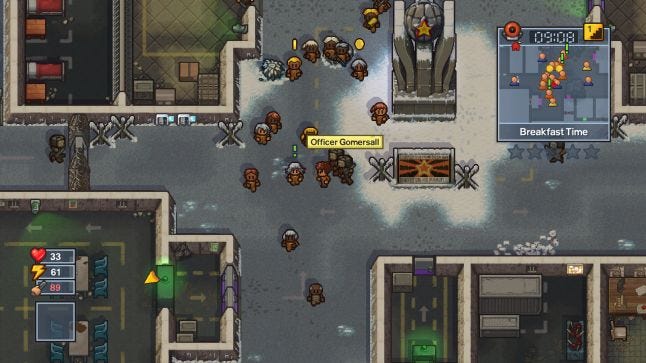
This new type of escape, along with added multiplayer, larger multistory prisons, a more nuanced favor system, would add new challenging ways to bust out of the big house.
Cellmates and strange settings
"We asked fans what prisons they would like to see before we started work on the sequel, and we got some truly out-there ideas. For instance, a space prison was much-requested!"
The sequel was partially made in response to fan input. “The Escapists was a big success, and seeing the fans response to the game and subsequent DLC was amazing," says Witcomb. "It very quickly became clear that fans really wanted multiplayer, but the only way we could get multiplayer to work was to re-write many of the game systems.”
The developers liked the idea of multiple people working together toward a similar escape plan, each dealing with different aspects of security. A sequel would also be a fine excuse to clean up some issues.
“This presented us with the opportunity to not only add multiplayer, but to work with The Escapists' creator Chris Davis to iron out issues with the first game, and show our gratitude to the community by taking on board their ideas and feedback via community surveys prior to starting development,” says Witcomb.
The fans, naturally, had some wild ideas for a new title. “We asked them what prisons they would like to see before we started work on The Escapists 2, and we had some truly out-there ideas. For instance, a space prison was much-requested," says Witcomb. "That offered a challenge for us to design!”
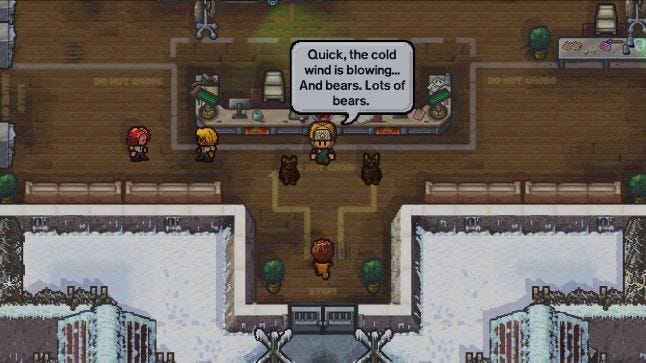
Features like this built off of the humor the original title wove into its prison break narrative, and also gave the developers some ideas on how to really branch out into new, unique escape opportunities. “Fans really responded well to the humor of the first game, from the despondent tones of the job officer to the random, meandering stories of the visitors," says Witcomb. "That tone really allowed us to add some more… ‘unorthodox’ escape ideas into the mix.”
Building better prisons
"Many of the prisons have their own unique mechanics, such as the one that's on a moving train."
The Escapists 2 would need bigger, better, more complicated prisons to give fans of the original some new places to break out of. Drawing upon some of their silly ideas, as well as a deep look at the mechanics of the original, would lead the team to help create those brand new break-outs.
This lead them to give many of the prisons their own unique mechanics, such as the prison that is on a moving train. This would not only make each prison stand out, but it would also give players a special means of escaping it, providing some truly special escapes.
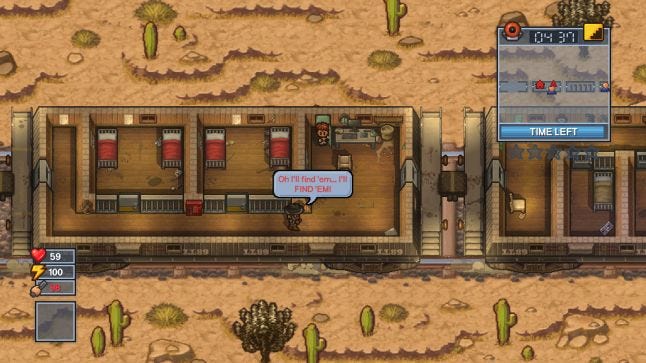
"One of the biggest level design challenges was the verticality of multiple-floored prisons."
“We wanted an escape that really instilled a feeling of having to find something unique about each prison that could be exploited, and the process of preparing for the escape. We added a brand-new type of ‘special escape’ which are themed and unique to each prison.
They may be to find and fix up a vehicle, or construct a device to fire a zip-line across to a building outside of the prison. On completing one of these special escapes, a cinematic shows the player(s) escaping via this unique method,” says Witcomb.
This would give players something really new to work toward, granting them something that was vastly different from what they would have seen in the previous title. It wasn’t just the theme of the jails that would change, nor the silly nature of some of the structures, but also the size of the prisons involved. Something as simple as making the prison cover multiple floors was also used to make breaking out more involved.
This would create some challenges for the developer. “One of the biggest in the level design in The Escapists 2 was the verticality of multiple-floored prisons. We had to now consider not only where a room was located in the prison, but also what rooms were directly above/below it, and whether a vent system would allow access between them,” says Witcomb.
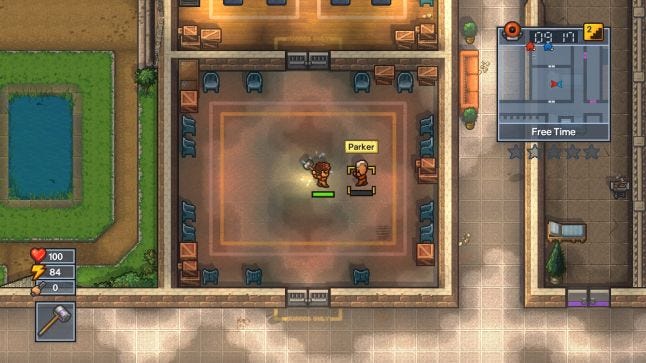
"Favors were an integral part of earning currency to buy escape materials in the first game. We created a much larger library of favors, with much more randomness in the requests they make,"
It wasn’t just the layouts that brought new considerations with them (and therefore more opportunities for players to plan their own escapes), but also the new prison themes.
“We had to pay attention to the layouts of buildings to ensure that they visually looked interesting and fit their intended theme, but to try and retain an ‘evenness’ to the different escape options available to the player. For instance, we might put an outbuilding next to a perimeter wall, but to balance the shorter distance, the player will need to dig to get out of the prison, that outbuilding may require a certain key to access, or may only be accessible via a vent on the roof.”
Their concerns weren’t just on building new things, though. Features from The Escapists would be brought back and improved upon for The Escapists 2. “Prisons in the new game have a footprint roughly four times that of the first game (that’s before we even take multiple floors into account!) so we had to make sure there was enough to keep players busy whilst figuring out their escapes.” says Witcomb.
“Favors were an integral part of earning currency to buy escape materials in the first game, and they received some criticism for their repetitive nature. We created a much larger library of favors, with much more randomness in the requests they make,” says Witcomb. “We also added multi-part favors which allow a single inmate to give multiple tasks to the player as part of completing the overall favor.”
No tags.