
For years I've been taking a pretty standardized approach to designing each new map in Cogmind, and although we have dozens of them now, it's one of the few topics I've never covered on the blog. This is essentially because a serious in-depth look at the entire process would require spoiling a lot of content, considering that all the most interesting maps have been located beyond the early game.
But with the recent release of Beta 8, which adds a very interesting map right to the early game, we now have a good opportunity to discuss map design without worrying too much about spoilers, since for the most part it's easily accessible content anyway.
This article will walk through every stage of the design and implementation process, from start to finish. I took a lot of notes about the process itself as I was building Beta 8, specifically so I could share them here and to ensure that what I write is an accurate representation of what actually went down.
Note that unlike the majority of maps in Cogmind, due to its nature this particular map has a mostly static layout and content rather than drawing heavily on procedural methods. As such the process is missing a few steps, but I'll cover those separately in an addendum. A mostly static map, on the other hand, provides some unique discussion opportunities of its own.
Conception
Before even starting, each map idea needs one or more concepts to build around, and in this case we have several goals:
add more potential variety, especially to the early game
provide more early plot hooks
help new players
For a very long time my notes for potential Cogmind features contained the concept of "derelict labs," a way to access strange and fun technology, so when I started feeling we'd need a new area of the game to achieve all those goals, this concept seemed particularly fitting.
Once I'd decided this was likely to happen (several months before actually doing it), I began intermittently revisiting that section of my notes to expand it with new ideas and considerations. On each new visit to add more ideas, I'd intentionally avoid rereading previous notes on that topic, instead just appending any new thoughts at the bottom. This keeps me in the unique frame of mind I'm in at the time, allowing me to come up with potentially very different ideas, or even perhaps the exact same ideas again without realizing it :P (this because usually days or even weeks have passed and I've forgotten the details of my earlier ideas). Note that coincidentally repeating notes on the same ideas can actually be valuable, because it validates them, perhaps with different reasoning, or even fleshes them out in different directions I hadn't thought of in previous note-taking sessions!
This process resulted in a total of about 2,600 words of rough notes on the topic, which like all of my notes are organized as nested lists in a TXT file.
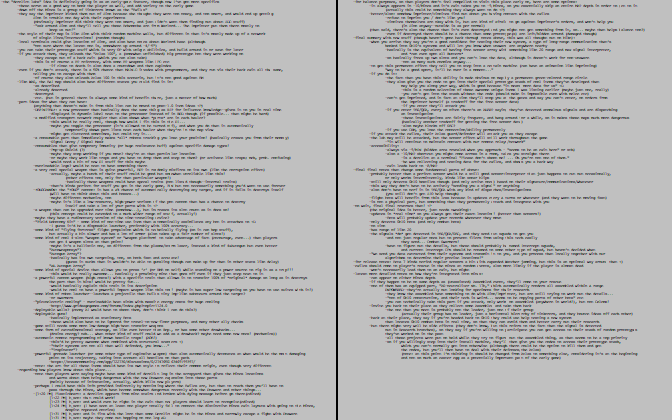
Cogmind Exiles Map Rough Design Notes (overview)
The entirety of rough notes on the new map, as seen in my editor.
Normally I just delete rough notes once their contents have been implemented or converted to more permanent notes elsewhere, but this time I saved them to share with you. Download/read the original notes here (you'll need line wrapping off to view them properly!). Since the notes are a top-to-bottom process, you can see how they kept getting longer and longer with each extension as I apparently went back and forth on various points. There's even "final summary" followed by the typical "final final notes" followed by "no wait, final final reverses that" xD
In short, a new mini-faction of "Exiles" from another community has their own lab, offering the player both a new sensor ability (dubbed "FarCom") and access to prototype gear from among a pool of possible items. Story-wise, they become the player's earliest significant exposure to the world's lore. As such, it's good that I've circled back around to add this map after the rest of the world is already completed, so they can hook into it properly based on my knowledge of how everything can play out both in terms of story and gameplay. The alternative, trying to build this map from the start, would've likely meant repeatedly updating or changing its contents as the rest of the world was built. (Cogmind's world was almost entirely built from beginning to end, rather than skipping around.) I'm not a fan of ripping out or making significant changes to old content, preferring to get it right the first time.
So back in late October when it came time to add the Exiles, the first task was to reorganize those rough notes. This normally means reading back over them to remove the stupid ideas, refine rough ideas, and generally consolidate the notes while expanding on any unclear points, making sure it all fits together in support of my vision for the map.
I didn't spend very long in this phase, though, because there were simply too many notes this time around, and more importantly they were just going to be converted to a new form shortly afterward anyway. After just deleting some unnecessary chunks and making a few modifications, I quickly started on the proper map design doc.
Map Design Doc
The last planning stage before actually working on a map is to finalize all its relevant notes into a basic format I've been using since the beginning of Cogmind Alpha.
Each map generally has its own text file describing its design. I call these text files "supplements," since the idea originated when I started using these external files to supplement Cogmind's original design doc, a massive file which started to get a little unwieldy by the time the first public Alpha was released after two years (plus I didn't like the format/program that was used to create the original doc and wanted to start moving away from that, and by then the entire primary design doc had been implemented anyway).
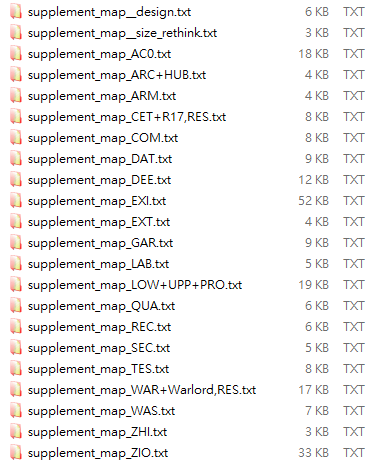
Cogmind Map Design Supplements (file list)
Supplements for various maps added over the years. "EXI" is the code for Exiles--note its size relative to the others. It happens to be one of the more complex maps, with a lot of possible content and various scenarios.
Map design docs break down their contents into a number of common sections, including at the very least the following:
goal: Main purpose(s) behind adding the map to begin with
layout: An overview of environmental factors including the terrain and any props the player will see
inhabitants: Descriptions of all the entities (in Cogmind's case, essentially robots) found on that map
gameplay: Primary interactive elements of the map, including any cause and effect related to dynamic content
These are the main four, but some maps have one or two additional note categories applicable to that map in particular. For example the Exiles design doc adds a "location" section, because unlike most maps there are a number of important comments to make regarding how to access this map in the first place, and its general position in the world. There's also a large "part concepts" section for collecting ideas for their stash of prototypes.
You can read the entirety of the Exiles map design doc here (again, turn off line wrapping). If you checked out the rough notes earlier, you can see how they evolved into the proper design doc, which weighs in at three times the size (about 7,500 words). Some of the minor details in this doc may not be the same in the final implementation since I sometimes make last-minute changes that aren't necessarily reflected back in the notes, but it's mostly accurate.
High-level Design
It's extremely important to expand the initial map design process to include considerations beyond the map itself. How that map fits into the bigger picture with regard to overall player strategy should be determined in advance, since it can have a broad impact on a map's content, and if not careful a poorly planned map could end up needing more significant changes later on if players find that it's either not very interesting or useful to them in the long run.*
(*There is currently one optional map in Cogmind which unfortunately fits this description: Recycling. It's a relatively simple, small map with some unique mechanics of its own, but its advantages aren't really as enticing for players as I had first envisioned them when it was created early in Cogmind Alpha. Back then I was just getting started adding optional maps, and have learned a lot since then, including by way of the player community as it's matured. I have plans to improve it one day, but it's not a pre-1.0 priority since it's rather out of the way anyway.)
I wouldn't want to waste player time, or my own, so the Exiles map in particular has a number of long-term strategic implications, and properly building them into the experience as a whole involved addressing different kinds of player needs, goals, and... um, craftiness ;)
Like pretty much all of the many optional branch maps in Cogmind's world, the Exiles offer tradeoffs, making certain areas easier while increasing the challenge level in others.
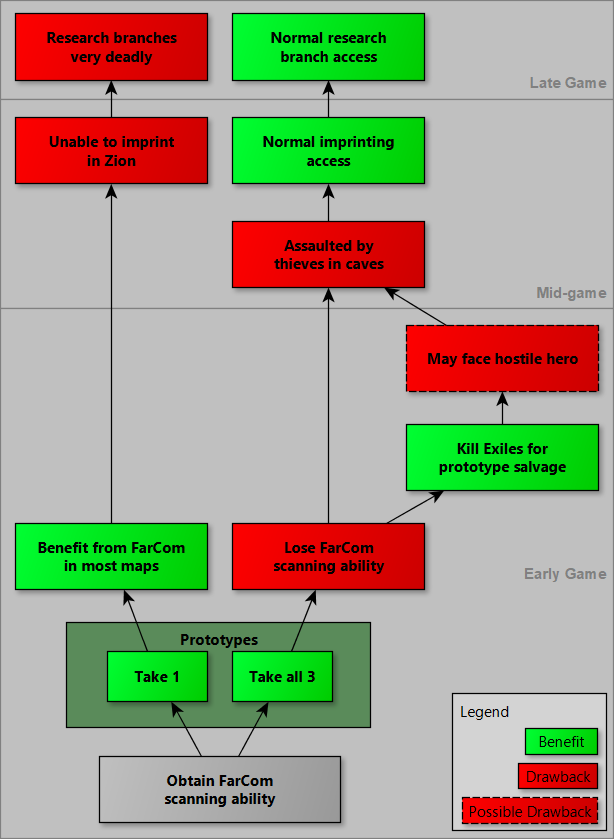
Cogmind Exiles Design: Strategic Flow
Primary long-term strategic decisions related to the Exiles. Note that some "drawbacks" may even be seen as good (or at least neutral) by certain players, so there are alternative interpretations to this graph as far as coloring goes. (I've chosen the most common view.)
There are other random Exiles scenarios which can affect the available options, but I'm covering just the most common one here. Also, graphed above are only the major strategic considerations--individual prototypes can change a player's potential route or even suggest builds depending on what they are, because they're selected randomly from a pool of possibilities. Overall this one map has really opened up a lot of new options! I'll talk about these options in more detail later.
As designed, the standard Exiles benefits (one free prototype + FarCom) are especially noticeable in the short-term, at the expense of long-term drawbacks, making them a great choice for new or inexperienced players. That's not to say they can't be useful for experienced players as well--already one player won an extended run despite using FarCom, which essentially makes late-game Research branches off limits, even though that's where one normally accesses a lot of the most effective tools for tackling extended game challenges.
Having tradeoffs makes visiting the Exiles much more interesting, and they're essential, too, because without tradeoffs it would be easy for a player to become overpowered, and a no-brainer to route a run through this map. Naturally not every map needs such explicit drawbacks, since in a lot of cases the drawback is the inherent cost of reaching and/or fighting whatever is in the given map, but here I should emphasized that the inhabitants of this particular map are all friendly, and reaching it is quite easy, so stronger measures were required.
Okay, planning is over, time to start doing.
Building Blocks
As we already have our high-level analysis and relatively complete plans to guide construction of the new map, the first stage is to put together its entities and items, basically any individual objects that can be created in isolation. This would be the "pieces before the puzzle" approach, breaking down a large project into its smallest parts and working on each of the latter first.
But I'm not even adding them to the new map at this point--it doesn't even exist yet.
Since there's a lot of work to do for such a giant chunk of content, trying to add each new element to the map as it's finished would often involve thinking at multiple levels (local area, map-wide, game-wide...), which is a lot less efficient than focusing on as few aspects as possible without constantly bouncing around. Working efficiently is not only faster, but also gives better results.
So the plan here is to get all the pieces in order, then put them together all at once.
Personally I like to start with the pieces that require the most time to implement, which for me includes most importantly anything that I think would be fun and interesting but is ultimately "optional" when it comes down to it, such as certain rare special events, items, etc.
Stuff like Beta 8's time travel-enabling "Chronowheel" item took forever, one of those things where I'd say "okay I'm going to tackle this one today," then at the end of the day it's "okay, I'll just have to finish this tomorrow...," and then a couple days later I'm like "uh, really gotta finish this thing up today!" (and maybe still don't xD)
But this is the type of content that really makes the project feel more like what it really is, a world built out of passion rather than just a "good enough game to sell and keep the lights on." If I leave this tough optional stuff until later in the release cycle, it's more and more likely to get dropped as I see the deadline approaching and there's still so many other necessary tasks left to do, not to