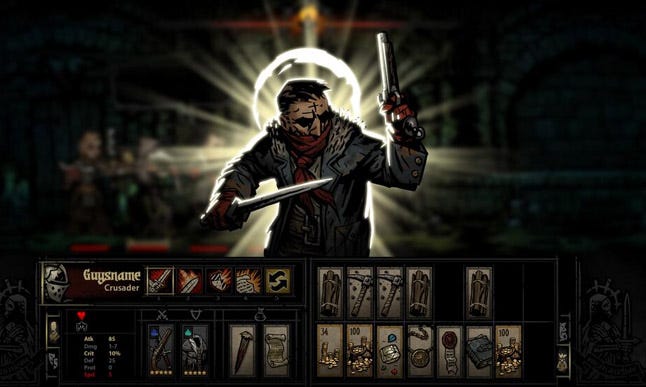
Darkest Dungeon launched on Steam Early Access at the beginning of February and, in stark contrast to its frayed and ill-fated adventurers, ascended quickly towards the top of the Steam charts. In a climate where Early Access has become something that is lately treated with more suspicion than excitement, that's no mean feat. However, following a successful Kickstarter where Red Hook Studios raised over $300,000, and launching with a game that felt closer to a finished release than an alpha version, Darkest Dungeon happily bucked the trend.
Not only this, but it came to the table with a striking art style and a powerful concept; that as you guide your intrepid adventurers through procedurally generated dungeons and face ever more horrifying adversaries, it isn't solely their physical health you have to concern yourself with. They slowly accumulate stress as things go wrong, until they reach a moment of crisis and either crack -- developing negative traits such as masochism or paranoia -- or rise to the occasion and become stalwart, or heroic, or basically all the sorts of behaviors you might want in the thick of battle.
It's a very original and successful mechanic, woven tightly into the core loop of the game: Plunging into dungeons and then sending your adventurers off to the brothel or the abby to work off the stress, providing they survive. It's also incredibly unforgiving.
Talking to Chris Bourassa, the creative director and lead artist at Red Hook, and Tyler Signman, Darkest Dungeon's designer and producer, we discuss whether they're limiting their audience with the game's difficulty, as well as how the stress mechanic is pretty much a metaphor for game dev crunch.
You’ve had a very successful Kickstarter, and you’ve now had a very successful Early Access launch, releasing a game that feels very comprehensive, which is unusual for Early Access. Was it always the intention to wait until it was at this point in production before launching Early Access?
Chris Bourassa: I think it’s just been our strategy all along; that when we’re bringing something to the public that we make it as good as possible. Tyler and I have always talked about that as something we wanted to do. When we did our Kickstarter we spent a lot of time researching carefully and taking our time to craft our pitch. Basically not taking anything for granted to make sure that we had some level of success. Our attitude to Early Access was the same, and to make sure we spent our time in Early Access getting community feedback, data, and making the game better and better as opposed to making hte game workable.
Tyler Sigman: It’s been fun to see the response to Early Access because the game’s not done, and there’s a bunch more that we’re going to add in, and it’s funny because it’s one of the best compliments to hear people say "it feels finished." Internally it doesn’t feel finished, because we know all the other things we’re going to do, but we definitely didn’t want it to feel janky.
It’s that old adage that you only have one chance to make a first impression, but each step in development, starting from the first trailer, to Kickstarter, to Early Access, and hopefully leading into 1.0 release, at any of those steps you can make yourself a bad impression. So passing each of those checkpoints has given us enough fuel to get to the next, but it’s still really important to make sure people are happy about it.
CB: We love the game too, and while obviously it was our strategy to put our best foot forward, there was a lot of love for what we’re doing, and I feel like that helps and carries through.
TS: We’ve been pretty fortunate on time, but I think when we released our first trailer it was a little later than we’d planned, and when we went to Kickstarter it was a little later than we planned. Even when we went to Early Access it was a little later than we planned, and with every one of those we were given the choice of "Is it ready, or do we launch it right now?" we always make sure it’s ready, even if that delays the release.
The big draw with Darkest Dungeon is that your heroes’ mental health is just as much a consideration as their physical well being, and I think that’s one of the main reasons the Kickstarter, and now the Early Access, is doing so well. Were you always aware that that selling point would be quite so powerful?
CB: I think the idea was what really generated a lot of enthusiasm in us to get it up and running, so we knew it would carry some weight, for sure. But we didn’t want to take anything for granted; a lot of people have cool ideas. So we had to really work hard to refine it and make sure that we didn’t just try to sail on the strength of pure concept.
TS: We also tried to do a couple of other things. We learned from other projects, both the games on Kickstarter that did well, as well as those that didn’t, but we also tried to bring our own unique standpoint.
I remember when we were launching our Kickstarter the predominant standpoint was that you introduce the team, you create a personal bond, you do all these things that let people know that you’re going to do your best, but we went the complete other direction. We didn’t even introduce ourselves in the Kickstarter video, it was all game. Because we figured that that was what matters in this particular case.
This game has to stand on its own, and if you’re interested in the team you can scroll down and find out that we’d made games before and it wasn’t our first, and you can have a little more confidence that your money isn’t going to vanish. We tried to take a different direction where we learn from what other people are doing but put our own stamp on it.
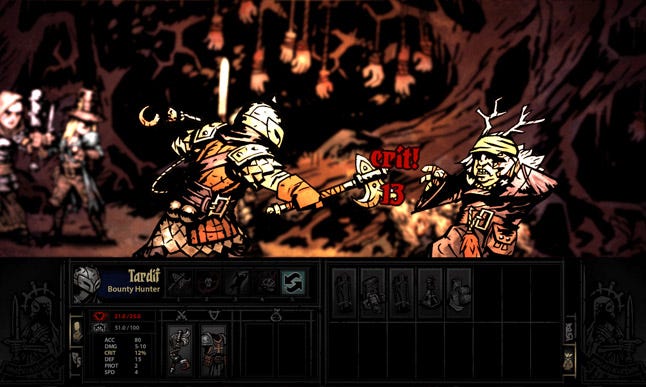
One of the things that surprised me when I started playing Darkest Dungeon was that that selling point of the stress mechanic is important to the game, but what was pulling me in was the strategy and depth of the different mechanics to do with positioning your heroes and your enemies. Along with the art style and general tone, it feels very separate from many Early Access titles in that there are no big holes in the development of the game that still need to be filled in. To go back to your comment about not sailing purely on the strength of the concept, is this something you’ve aggressively pursued?
CB: We iterated a lot on combat because we knew that had to be a pillar that would hold everything up, but we always tried to be cognizant that a game is a lot like a band, and if you try to make every feature the lead guitarist the whole thing is going to fall apart.
Not every part of the game is equally developed, but not every part needs to be. There’s definitely a hierarchy of interest and challenge, and the features are organised in such a way that the mechanics of combat give way to the meta-strategy of persistent stress, which dovetails into where you’re putting your guys, and the mini-game of putting your guys the stress-reduction facilities. So certainly not every part of the game is as developed as one another, but that’s by design; we took what was strongest and focused our time on them.
TS: We talked about this internally a lot. The stress and affliction systems are like a cherry on top. It’s more than just a cherry, and it’s some of the unique flavour, but ultimately we still had to build an RPG. It’s kind of funny because there were times during development when we realised that there were plenty of times during development where we had to spend our time making things that weren’t the secret sauce, but the game only works because it’s basically an RPG with these other elements added on. So we had to invest in these things that weren’t related to stress to make sure that we had that solid base of an RPG before we came in and added what was special about it.
Another thing I find interesting about that is that you do need to build that established RPG before you add the Stress mechanic, but once you have added it you’re essentially adding a system that’s almost as complicated as the one you had before. Does that make it a nightmare to balance?
TS: I think the key is modularity. It’s definitely more complicated because you can just look at combat by itself and say, from a really simplistic bird’s-eye view, that you’ve balanced the combat exactly right. But then you come in and say, "Well, sometimes adventurers are going to be crazy and they’re not going to do what you want them to do, they’re going to resist heals, they’re going to attack party members, they’re going to stress party members out." So if you’re not keeping that in mind, the temptation would be to balance combat to be just right except for when things go wrong due to the stress mechanics. So you definitely have to account for it. I think that’s a challenge, but it just goes with the territory.
We are fortunate. It’s not like we knew going in it was going to be a smash hit. We hoped it would be, but we definitely felt we needed to attend to the core gameplay. Chris originally came up with the idea of how they’re presented on the side, and we were able to draw back on classic RPGs and add some other mechanics, but we knew that if we could make combat fun on its own, and then you add the affliction system, then it’s going to be really special. That was our goal, to make sure that the systems stand on their own, but when you bring them all together then you have something special. It’s just easier said than done, and we’re still not taking it for granted, we’re hard at work on making it better, we’re just glad that it is being received so well.
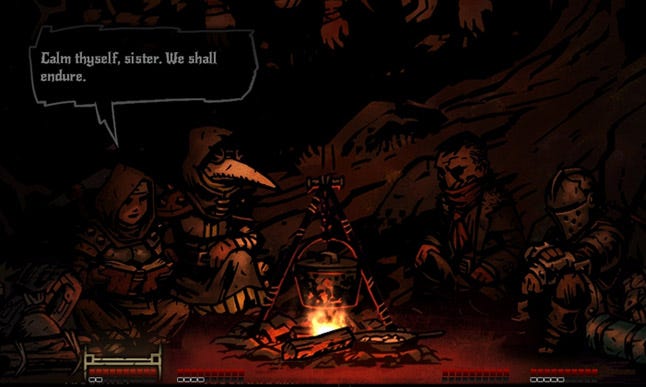
In regards to that reception, it seems that Early Access launched and it was picked up by all the sorts of people that you might hope it would be, such as big streamers and large personalities. How has that been as a developer, when you see it being broadcast from such large platforms?
CB: It’s hard to put into words, it’s very very validating, for sure. Because there’s a whole lot of risk and uncertainty that goes into this, so you just never know where you’re going to land, despite doing everything you can to chart a course for sustainable success.
Seeing the uptake in the press, and the reactions by streamers, and watching the streams themselves has been incredibly rewarding and validating, and makes the game even more real for me, weirdly. Because you’re solving problems for so long, and you’re working on content, but you can lose fact of the sight that it’s a game to be played, because of all the work you have to do. So when someone sits down and they go through the emotional journey that you intended to take them on, that feels incredibly rewarding, for sure.
And is there a flipside to that, where, because it’s a very systemic game, you see all the flaws and bugs being blown up and exposed because of that attention?
CB: Oh totally, yeah. But that’s why our approach to Early Access is really valuable to us, because we get to see things like, "Oh, there’s a stun-lock exploit that can ruin the tension of the game." We’re getting lots of feedback that Trinket X is underpowered, or overpowered, and you see that stuff in practice. So you get a really broad look at the game, and see where you’re underdelivering in areas where you need to just sand down a few rough edges, so even the bad stuff is kind of good, in that way.
Which is one of the advantages of Early Access, in a way. As you can soft-launch the game.
CB: Exactly. We don’t want to get reports that the AI doesn’t work, or that the UI is confusing, we’d rather spend our time considering the playtest data and how we can improve the game. And that’s why we spent so long waiting until we had something that was relatively self-sufficient and solid before opening up the flood-gates.
I’ve seen a lot of people talking about the strength of the narrator and how much personality he has in Darkest Dungeon. Were you prepared for the strength of the reception to the narrator himself? And I’ve seen people asking for a Dota 2 announcer pack, is that something you would consider?
TS: We’re actually spooling up a pack, as we speak.
CB: It’s very timely that you asked about it today, actually.
TS: But yes, we’ve been in love with the narration all along, and when we were talking with our Steam contact months ago we were asking what the process for [making a Dota 2 announcer pack was]. Just thinking that if the game did well it would be rad to do.
We just didn’t expect that the time would be right now, immediately after launching Early Access. It’s fantastic. But yes, we fell in love with Wayne [June]’s voice, when we used him on that original trailer. And honestly, just how great he fit the trailer made Chris and I say that we had to use him in the game, too -- we can’t just use him in the trailer, we need to find a way to make this part of the whole game.
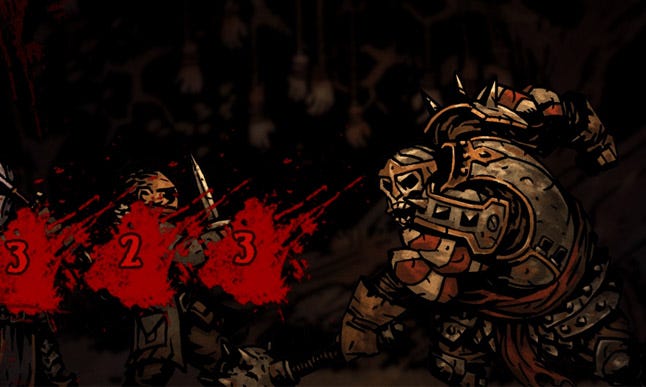
It does seem like there are a lot of different elements, from the mechanical side of the stress and combat to the art style, the narrator, the lighting, all working together to really sell that this is an unpleasant, stressful situation. Was that hard to achieve?
CB: I’m not sure about hard, but it’s definitely something we were constantly conscious of. I think that’s one of the advantages, or at least a great thing about how Tyler and I work, in that we just agreed on what the game needed to be, and then threw everything we could on reinforcing that vibe.
So everything from enemy crit chance to the art style are all designed to communicate that core message of, "Yes you’re underpowered, yes you’re vulnerable, focus up, think carefully, and this is really really creepy and hard to do."
But all of that is manifested through the narrator, because we wove him into this disembodied, ghostly voice that sardonically comments on your success and knowingly nods when you fail. That’s part of the story of the game that we’re going to expose when we launch. So that’s going to be very exciting too.
TS: Even the take selection -- often times he’d read a few different versions of the same line. He’s great because he gave us variants to work with. But even with the take selection, we had to be careful to be consistent with reinforcing how we wanted you to feel. Raising the stress, and making sure that it’s the right message.
In regards to that, I’m quite prone to get frustrated when random chance goes against me, and I find that when I’m playing Dota, which has a lot of things that you’re not remotely in control of, I use the Bastion announcer because it’s the most calming. With Darkest Dungeon when something goes really badly against me, getting ground into the dirt by the narrator just made it that much worse. Was that something you considered when putting it together?
CB: Definitely. He chimes in randomly most of the time, but we wanted to make sure that when it all lined up his tone and delivery gives us what we as the developer want you to feel as the player. The voice direction was that successes should be commented on bemusingly, as if they’re unexpected, as in, "Good job little ant, for getting the bread across the table."
Whereas defeats are talked about almost as if they’re inevitable. He only really gets his blood up when you start massacring and doing these big hits, and then he starts yelling more video-gamey stuff. We wanted to hold that back, so that when it did drop and when you did one-shot an enemy, Wayne is there really riled up, and it feels really awesome. And that gets you through some of the low times when he’s really bad-mouthing you.
Are you ever worried you’ll push a player too far and they’ll quit the game completely?
TS: I would say that we know that could happen, but one thing that’s served us well throughout development is that honestly -- and it is hard to keep to this, but it’s not a game for everyone. Even when we started there was some darker stuff we were going to get into, but while you’re playing it’s dark, it’s people getting hopeless, masochistic, abusive, paranoid. That’s the DNA of the game; it’s punishing. Sometimes unfairly, and we’re looking at some things to do with the RNG in general, but part of it is intentional that no matter how well you plan, it can get away from you.
CB: That’s really the core.
TS: So the concept that some people might go, "Fuck this game! It’s not for me." Philosophically, we’ve always been ok with that.
No tags.