The Gamasutra Deep Dives are an ongoing series with the goal of shedding light on specific design, art, or technical features within a video game, in order to show how seemingly simple, fundamental design decisions aren't really that simple at all.
Check out earlier installments, including building an adaptive tech tree in Dawn of Man, creating comfortable UI for VR strategy game Skyworld, and creating the intricate level design of Dishonored 2's Clockwork Mansion.
Who: Hannah Nicklin, of Die Gute Fabrik
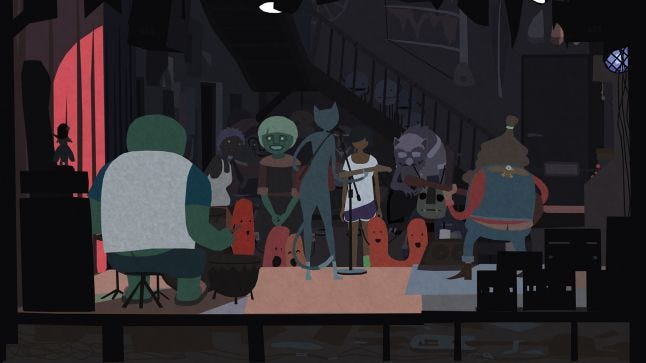
Hi, I’m Hannah Nicklin from Die Gute Fabrik. I am the narrative designer and writer for Mutazione – a mutant soap opera where small-town gossip meets the supernatural –which was released in September 2019 on Apple Arcade, PS4 and PC. I’m now CEO and studio lead of Die Gute Fabrik.
Before transitioning to video games as a main practice, I also worked as a playwright and theater-maker, and I have a PhD in the spaces between games and theater, and their uses as anti-capitalist practice.
My training is in theater-writing, and I correlate the role of narrative design very strongly to that of ‘dramaturg’ in theater. A dramaturg’s job is to look at the structure of the storytelling, and storytelling through the structure; it’s a systemic look at narrative which I find doubly satisfying as a practice in games, where player choice becomes a new factor, and narrative design tools a new limitation.
My early career practice as a theater-maker very much revolved around form-led design – finding the story you wanted to tell and then finding the best medium to tell it in, and also working tightly to brief. My theater-writing training focused on complex characterization, elegant exposition, and knowing when to break the rules usefully. This all equips me well for writing in games, as I can enter a project halfway through (as writers often have to) and be tools-focused: what are the affordances of existing tools in telling a story? What additional tool or feature would shape this storytelling most usefully? Alongside dramaturgical instincts about time, structure, and giving themes room to emerge naturally.
Parenthetically, I strongly recommend game designers seek out non-traditional theater and performance events near them as part of the work in other media that influences them, I think the perspective is really valuable for people working in games.
Vocabulary
I think specialist vocabulary around writing is sometimes thrown around a little interchangeably, so from my own perspective and learning, this is what I mean by these specific words (some of it is Aristotle by way of E. M. Forster, some of it is my own):
Story: the total thing you will communicate (you might call it the lived experience of the characters).
Story-world: relevant when the game is set somewhere other than our world/reality.
Plot: the events that you choose to show in their specific time-linear order.
Narrative: The entire design of the telling of the story – for example, a narrative can contain several intertwining plots (in TV you might have an A plot, a B plot, and a season-long Ur plot – a narrative might also tell plot elements out of sequence.)
Narrative design: The specific discipline in game-writing which encompasses the design choices around: player interaction, choice and consequence, space, embodiment, game feel, mechanics and time in order to tell the story.
As a working example: in an episode of Star Trek DS9, the story-world is that of the Star Trek universe. The story is one of a group of Starfleet employees attempting to mediate in a border-town space station between a community recently freed from occupation, and their occupiers. The plots may be ‘the barman has a comedy scheme’, ‘the previous insurgent has to tackle some of the moral grey areas of her previous activism’ and ‘the Captain has to keep the fragile peace whilst also being a good father to his son’. The narrative is the order of scenes, what they depict, who is in them, and how they interact throughout an episode.
What: Shaping the narrative of Mutazione
When I came to Mutazione (pronounced as it is in Italian [muh-taht-zee-own-ay] /mutatˈʦjoËne/) the game had been in development for around 6 years (though not all full time). As part of my brief I was presented with a fully formed story-world and set of characters, and a plot for the overall game. There was a system for writing dialogue which wasn’t yet connected to the game, and a majority of the animations were already made -- meaning I had a limited palette of emotional expression.
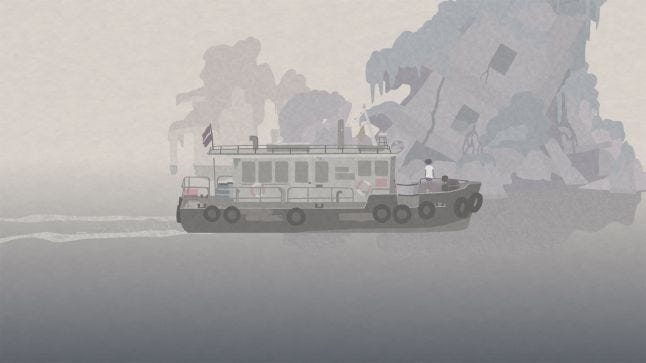
I was initially brought on to triage the writing. It quickly became clear, however, that there wasn’t yet a plan for the structure of the storytelling, how time worked, nor any clear logic systems for progression. This kind of systemic thinking suits me and as I began to collaborate (with permission) beyond my initial brief I was soon offered the lead on shaping the means and the telling of the story at the heart of this story-driven game.
At that point the brief became to implement Nils Deneken’s artistic vision to produce a game which was:
Driven by an ensemble cast of characters.
A soap opera.
Centered around a theme of looking at a community aligned differently with nature.
Built on a clearly defined and pre-existing story-world and plot.
How & Why
It’s important to admit, I think, that as many decisions are made in game development by process as by intent. Some processes you design, some you do not. My position on the team wasn’t one where I had full license to redesign the structure of the narrative and elements of the plot until the final year of development.
My involvement with the narrative design grew as:
The Creative Lead built confidence in my abilities to tell his story and change them positively without his oversight (it is a lot to hand over your story to someone else!)
I built my knowledge of the tools and systems in place to tell the story with, and was able to ask for refinements.
I was able to put in place systems for overview (many spreadsheets and filter functions).
We made some cuts. I love cuts. A single cut can allow you to see all of the lines of intent connected to it, and understand if it all needs to come apart, to serve the story best.
This is a quality of joining a project mid-way through and is at the base of many decisions and choices present in the game, which are still effectively first draft. My writing pals in other forms would be appalled at how much first-draft makes it into the ‘finished’ game.
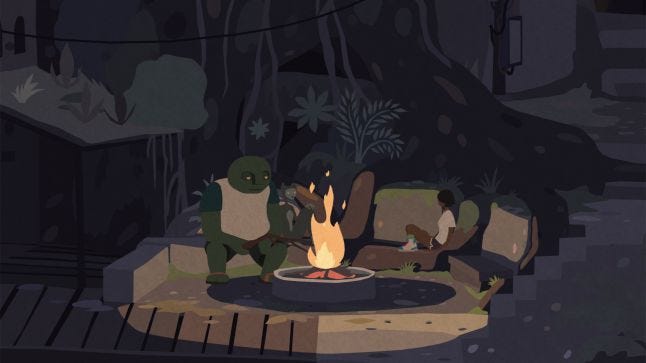
A mutant soap opera: genre
One of the things that was presented to me early on was that this was a soap opera. As a form-led practitioner I made careful note of the genre I was being asked to write within, and aimed to therefore make design decisions to serve this.
A few reactions to the game have focused on the ‘soap opera’ label as ‘wrong’ because they think it’s a ‘good’ game (um, thanks, though!) Genre is fairly neutral to me, on the whole, but I can understand that to non-writers, it is not. Nor is that reaction unique to games. In books, film and TV, ‘literature’ and ‘drama’ are often seen as the only place for quality. The masterful romantic comedy Pride & Prejudice is often placed in the ‘literature’ category, rather than in the reams of pink-covered rom-coms (give me a historical romcom secti
No tags.