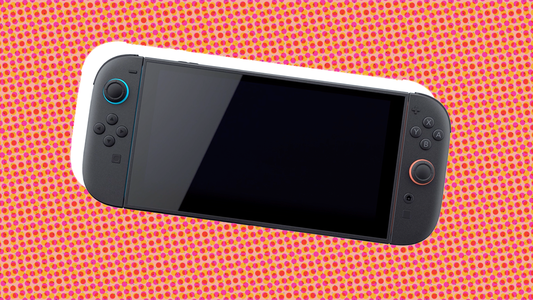

Raw Fury's late 2016 release Gonner is beautiful-ugly, violent-cute, hard-as-nails platformer in which you run and shoot your way through generated levels. Along the way, you meet Death, a maternal whale and a host of bizarre enemies, all against an abstract soundscape of intestinal gurgles and splattering. The game was warmly received when it debuted on PC, and it found a whole new audience this summer when a Switch version appeared.
"It's the least planned thing that I've ever done," says programmer and designer Mattias ‘Ditto' Dittrich. As distinctive and coherent as the final game is, it's fitting that something so weird should have grown so organically.
But it's still surprising to learn that its key feature was almost completely accidental. Namely, the modular way it defines your character's abilities through three wearable items. The head relates to your health and gives passive abilities. The gun shoots projectiles, and the backpack performs a specific action when you hit a button.
Together they comprise a build you'll be playing for your run. Gonner has strong roots in Rogue-likes, especially Spleunky's take on the form, but it veers away from them in one important way. If the Rogue template is to build your character with skills and items that you find as you play, in Gonner you fundamentally choose your build at the start of your run.
But they're not fixed. The important thing about Gonner 's items is that you can drop them. Lose your gun or backpack and you can't use them. Lose your head and you'll die from the next hit. From this simple rule Gonner finds challenge, surprising strategy, and a lot of its individual character.
<iframe title="Embedded content" src="https://gfycat.com/ifr/GoodDisfiguredGosling" height="360px" width="100%" data-testid="iframe" loading="lazy" scrolling="auto"></iframe>
After dying in Gonner, players must reassemble their component parts before returning to the fray.
"I thought, what if the head is an item that you can pick up and use for stuff? And that naturally became having different kinds of heads, and obviously, they would give you different abilities."
And it all came from an art mistake. Ditto draws every asset in white for the game, using code to colorize them, and he wanted the character's head, a skull, to be a different color from its body. But while testing it, he moved the character and saw the skull falling off the top of the body because he'd forgotten to connect them properly.
"I was like, oh shit, that's really cool," he says. "What if the head is an item that you can pick up and use for stuff? And that naturally came into having different kinds of heads, and obviously, they would give you different abilities. And then it just evolved. The gun should be replaceable as well. It had this snowball effect."
The function of the guns was obvious. They'd shoot projectiles in different ways. But the heads were more difficult to plan. At first they granted stat bonuses, allowing bigger jumps, faster running, more health, shooting faster. "That turned out to be super boring. You just end up picking the highest stat, and no matter how much you try to balance, there's always going to be the best one and you never look back."
So he and his collaborators, sound designer Martin Mathiesen Kvale and composer Joar Renolen, began to discuss abilities they’d like in the game. They felt that, even if they found a favorite, players would find it far more interesting to experiment with heads if they had very different abilities, just to see if they had a benefit. But more than that, the ideas they came up with also transform the way the game plays.
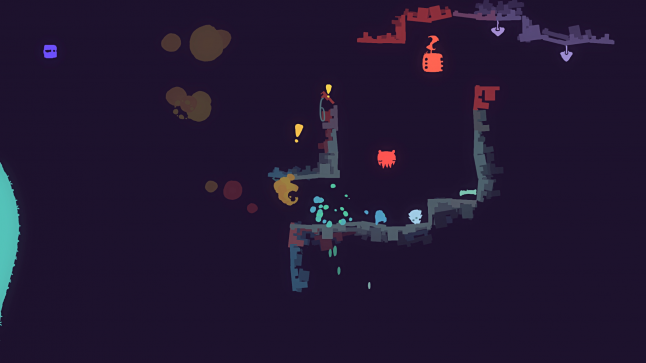
"Headless, gunless and backpack-less, your character devolves into a blob with a few seconds of invulnerability until it turns humanoid again. Until you get your head back, it’s game over if you get hit, and until you get your gun, you can only jump on enemies’ heads to defeat them."
There’s Gun Head, for example, which shoots bullets as you fire your actual gun, and grants you just one hit point. "It’s a super glass cannon, but it does a bunch more damage so it’s more interesting for someone who’s played the game a lot and is aggressive and going for score. That balance is cool, it gives the game a difficulty level, even though it doesn’t have one."
Flame Head causes enemies to explode when they die, and makes you immune to explosions, and gives you two hit points.
The teddy bear-esque Flip Head gives you a triple jump, spinning the character 360 degrees on the third jump, so you can fire at angles other than horizontally. "It just made us laugh, because we started doing backflips and shooting enemies below and it felt badass."
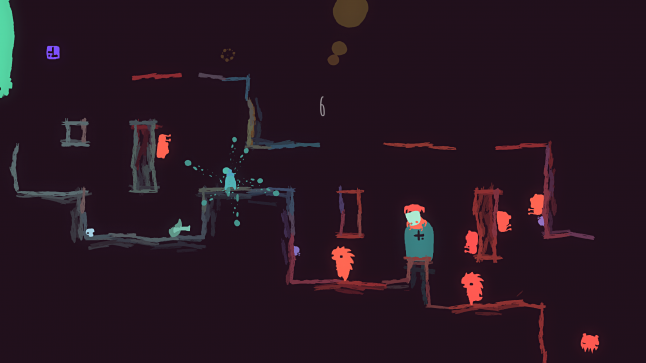
On your first play of Gonner, you have the Skull Head, which at five hit points has the most health of all the heads in the game. Skull Head’s reservoir of health gives a new player a chance to get through the first level while also teaching them one of the game’s core rules, which is that whenever you get hit, you drop all your items.
This is where the modular nature of Gonner’s abilities comes into focus. Headless, gunless and backpack-less, your character devolves into a blob with a few seconds of invulnerability until it turns humanoid again. Until you get your head back, it’s game over if you get hit, and until you get your gun, you can only jump on enemies’ heads to defeat them.
These panicky few moments of powerlessness can lead to both hard luck and hard decisions. If it’s too dangerous to get to your head, or if it falls off a platform and into the void, you’ll have to play on until you find it located somewhere on the next level.
No tags.