
Dead Cells is a sidescrolling rogue-lite action platformer filled with generated twisting corridors, clever foes, and an array of weapons for players to uncover in the game’s stages. Fifty weapons, to be exact, and each of them offers a change in how the player approaches foes and combat.
“One of the big inspirations for Dead Cells is the Binding of Isaac," says Steve Filby, producer at Motion Twin, developers of Dead Cells. "That game is entirely based on the choice of items that you get. That’s the fun of the game.”
Weapons do provide a lot of fun for players of Dead Cells, offering multiple ways to play the game, and they’re as entertaining as they are due to a lot of work and consideration to their purpose, effects, looks, and changes they make in how to play the game.
A sword’s shifting purpose
“When we started out, Dead Cells had a tower defense aspect to it," says Filby. "You can see the legacy of that in a lot of the skills that are available, like all of the turrets and the things you can throw down and leave. They were the primary weapons when we first started development.”

Ice grenade, diving Stomp attack, and rusty sword
"The idea is to let players try new weapons and see if they have a synergy with a secondary you’ve got. Play around with it. Have fun. Don’t get too attached to one weapon, and don’t work too much towards always having the same play style."
“We realized that wasn’t very fun – that wasn’t working. So, we moved away from that, and we said ‘Ok, we’ll take ownership of the action platformer side of things and moved to a full action platformer," says Filby. "At that point, Seb (Sebastien Bernard, lead developer/designer) said ‘You know what I love as gameplay? The Engineer of Team Fortress 2. You know how, by yourself, you’re not all that strong, but you can use your extra skills to just dominate?’”
“So, we said, let’s take that and use it," he says. "From there, as we started making it more and more action platformer-oriented, we realized that we’d put monsters in certain areas that make it difficult to fight. That’s when we started to add more melee-type weapons.”
It wasn’t just a means of giving the player the appropriate tools to deal with the types of enemies the developer included in their game, though. If that was the case, having a single ranged and single melee weapon could have solved that development problem. What the developer really wanted was for the player to have an ever-shifting experience over the course of play. An array of weapons with different play styles would keep things fresh and interesting through multiple replays.
“We’re not making a Dark Souls or a classic RPG game where you stick with one weapon and build it up," says Filby. "We’re making a game that’s faster-paced – that’s more focused on frenetic action – and is a rogue-lite, so based on runs. So, the idea is to let players try new weapons and see if they have a synergy with a secondary you’ve got. Play around with it. Have fun. Don’t get too attached to one weapon, and don’t work too much towards always having the same play style.”

Ice bow and whip
"You might really like hand-to-hand combat, but you’re going to come across a few of those ranged weapons and not have the choice, because they’re just so much more powerful and so much more interesting."
Subtle design choices encourage players to embrace that constant exchange of weapons. “As soon as you get to the second level, that sword’s not doing as much damage as you need to take on these new monsters," he says. "So, you’re going to have to change.”
“The difficulty curve of the game picks up along the way in order to force you to make that choice," Filby adds. "You might really like hand-to-hand combat stuff and not really like the distance arms, but you’re going to come across a few of those ranged weapons and not have the choice, because they’re just so much more powerful and so much more interesting that you need to change.”
It’s not all about forcing the player into a certain style. The weapons also ensure that the game features an element of strategy, adding that calculating element to the game through granting the player tools that may be better, depending on the situations that are coming up. “For example, in the Ramparts, on the roof, there’s two enemies in that area – flying, distance enemies – that are quite difficult to deal with," says Filby. "Now, procedural generation has given me a tower in front of me filled with a bunch of discrete rooms with these little guys. So, I need to pop into the room, aggro one, bail as fast as I possibly can, and then take him somewhere and deal with him where I’ve got a little bit more space.”
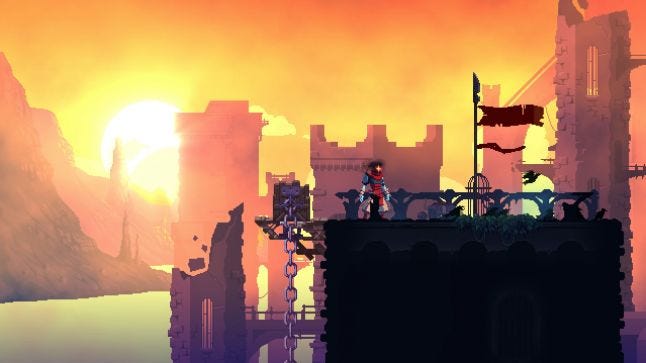
“Or, you can say that the weapons you’ve got, say a freeze grenade, a flashbang, or something that’s going to stun them and stop them, and I’ve got a fast weapon that’s going to allow me to deal a lot of damage," he continues. "You walk straight in the middle of them, toss the grenade, and take them out while they’re frozen or stunned.”
As such, Filby looks at the weapons as a means of giving the player different opportunities to come up with ways to get through a given situation. Some changes are imposed on the player through increased challenge, but they still have enough choice of tools to grant them different ways to get through challenging parts. “We don’t want the player to find themselves in a situation where they feel that the weapons they’ve got suck, because of the way the level’s been designed (with procedural generation). We want to give the player a sense of strategy as they run through,” says Filby.
The weapons have served many different purposes over the course of the game’s development, moving from a means to block oncoming enemies, to more action-oriented play, and then further refined with their stats and strengths to encourage a certain play style from the game’s players. They are not simply interesting combat tools, but are a means to extract a certain play style from those playing the game, and to enhance the possibilities for challenge and strategy.

A sturdy shield and a war spear
The beauty of the sword
Filby didn’t want to just throw a bunch of weapons at the player without making them truly interesting to play with, though. Forcing the players to switch weapons, imposing a change in play style, had to have some benefit other than just increasing damage. That wouldn’t be very appealing to some players, and so many efforts were put in to make sure each weapon felt unique, exhibiting different characteristics, powers, looks, and feels.
No tags.