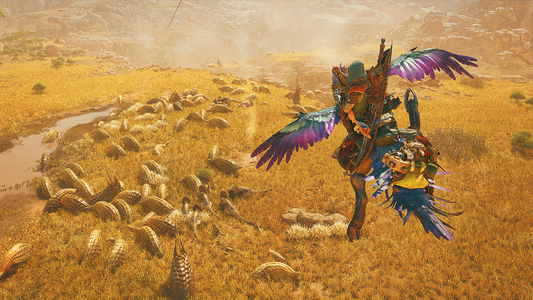

Anew: The Distant Light is a Metroid-style open-world game currently in development and nearing feature-complete. (We also have a Kickstarter underway.) This article discusses the practical application of some design theory for deep gameplay with examples in Anew.
What does it mean for a game to have deep design or deep play? This is a personal question with different answers for different people. To me, it means that a game has a large possibility space, dense with interesting player choices. It doesn’t require an endless game world (though the world of Anew is quite large) or hundreds of redundant items. It does, however, require thoughtful planning by the designer.
Deep design can be approached from the top down. The developer can create multiple roads (literally) to get from A to B, provide different viable methods to defeat an enemy, design multiple solutions to a puzzle, or lay diverse clues about the truth behind a mystery.

Going deep with Anew: The Distant Light
It’s not just about having options though. Each way should have varied advantages and consequences so that the player’s approach, conscious or accidental, has meaning. For some players this will involve an analysis to find the path of least resistance. Curious players will want to explore multiple paths. For the most skilled players the path chosen may just be an expression of their style.
A bottom up approach to deep design can also grow a game’s possibility space and create meaningful player choices. This is all about building interactions--how the functional pieces of the game (characters, items, and environment) affect each other. The results of many of these interactions should be designed, but with enough interesting game systems emergent play will also develop.
Emergent player options can be overpowered. If they're fun, and the advantage is only circumstantial or contextually limited (or can be made so), often the right design decision is to keep them. Though, such such things shouldn't be allowed to entirely overshadow other potentially interesting ways of playing.
But, why design for gameplay depth? The short answer is that deep gameplay creates positive emotions that feel good. Here are a few examples:
Agency: Simply, it feels liberating to have options. It’s also very fulfilling to know that your decisions caused your success, or at least allowed for it.
Epiphany: One feels clever after solving a puzzle or working out a new strategy that turns out to be effective.
Surprise: As a player, it can be a very satisfying experience to receive a revelation about the story, discover a new place in the game world, or to stumble upon a new trick of game mechanics. One of my favorite ways to evoke suprise is to challenge the player's assumptions about what's possible in the game world.
Mastery: Some of the most rewarding feelings in a game come from a sense of expertise--knowing that you’re good and being able to show it off. This requires a game to have a high skill cap, meaning that there is a long path of continued rewards and advantages for a player’s improvements in game knowledge, agility, and muscle memory.
Guilty Pleasure: As a player, it’s a fun sensation to feel like you’re getting away with something that perhaps shouldn’t be allowed. A good designer creates and allows many such opportunities.
Endearment: Fostering this is a lofty goal indeed for any game developer, but at least one can aim to create good replay value, which is often a prerequisite. Reliably touch on other emotions in a game that you've convinced the player to spend time with, and with some luck you'll capture this elusive feeling.
So, designing for deep gameplay seems like a worthwhile pursuit. Revealing that gameplay depth at a consumable pace is also important. A player shouldn’t be overwhelmed with decisions when they start. Early options should be apparent, satisfying, and have intuitive outcomes. The best games entice new ways to play and allow for accidental discoveries without too much tutorial. If a game is fun and deep, but the possibility space takes a while to explore, it helps keep players engaged and improves the replay value of the game.
These abstract design concepts are touchstones for many aspects of gameplay in Anew, but for equipment in particular. Let’s take a look at our bottom up design concepts applied to a couple of our player weapons.
We want to create meaningful choices and deep interactions between game systems. So, we could say that each weapon must have at least two unique combat advantages and two utility advantages, such as mobility or environment access. Through this design approach, even a standard issue SpringSteel Shotgun can yield deep gameplay.

Here are some uses for our Shotgun:
Easy to aim in panic situations
Can hit many targets at once
High damage is good for a killing blow (the only infinite ammo weapon with this)
Extreme damage at point blank range (all pellets hit)
Shotgun kick pushes player away from the threat you’re shooting at, helping to escape melee attacks after you get close without any special player dexterity
A well-timed kick can be used to increase jump height for dodging or for sequence breaking* before the Double Jump, the Climbing Gear, or the Jetpack are acquired
Shotgun kicks can also be used to escape jet-streams or to slow a precarious descent
Enemy knockback can throw them into environmental hazards or over cliffs
As you can see, there are many diverse and circumstantial reasons to equip and use the shotgun for offense, defence, and movement. The different uses are also varied on the amount of player skill required for success.
*Sequence breaking is when a player proceeds through a progressively unlocking game world in an unobvious way, shortcutting the typical route. One advantage is that this can yield access to items earlier, creating a spike in player power or options. These may or may not be intentionally designed into the content. See also Guilty Pleasure. |

In Anew, all weapons are designed to have unique roles. This helps make decisions meaningful while still growing the possibility space of gameplay.
Let’s look at a less conventional weapon, the Buzzsaw. This tool is powerful, but it spins up slowly, aims slowly, and slows your movement speed (especially once the sawblade is dug in).
Called the P-Saw by junkers, the Plasma Buzzsaw and renowned for its ability to scrap detritus in record time. It’s also surprisingly useful for humble explorers who tend to encou |