
Side quests can make or break your game — good ones draw players further into your world; bad ones may sour players on the entire experience.
To that end, we reached out to several game writers and designers for their thoughts and recommendations on great side quests — or games with generally-strong side quests — that every developer should study.
Their responses are summarized below, but first, courtesy of former Black Isle writer, designer, and Obsidian creative director Chris Avellone, here are four general guidelines to evaluate everything against:
A good side quest informs the main plot or the area it’s located in in all respects — lore, NPCs, even through the rewards you get.
A bad side quest is a quest that upstages the main quest in terms of stakes, enemies, or even the lore.
Side quests should be quick and fun to complete (15 min is the range I shoot for).
Side quests should use the core gameplay mechanics and avoid special case new functionality (or be careful with it). This includes having the same range of reactivity, choices, and consequences as a normal quest in the main plot, although the scope of the reactivity, etc. may be smaller.
The Witcher 3 — a masterclass in side quest design
"The best side quests in the business are in The Witcher 3," says Deep Silver Volition senior designer Brad Johnson, who did mission design on the past three Saints Row games. "Their side quests are more involved from both a gameplay and story perspective than most games' main quests. I expected to skip through some boring dialog and do some simple fetch quests but each one kept drawing me in and kept my interest. There were always twists, trying to throw off expectations."
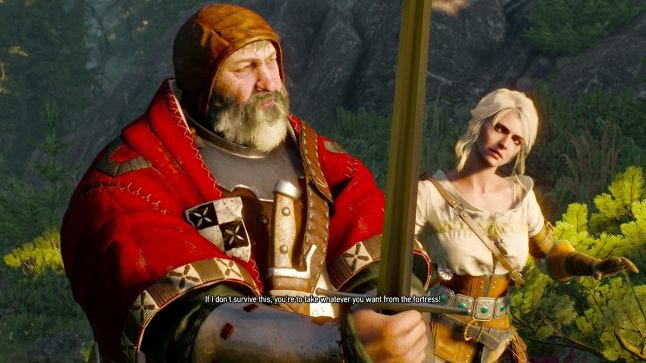
This was a conscious decision by developer CD Projekt, which wanted every quest — even the little ones about fetching or delivering something for somebody — to be memorable. Take one of the very earliest side quests as an example: in A Frying Pan, Spick and Span, the player is tasked with finding an old woman's soot-covered frying pan, which she'd been lent to a stranger who seemingly then nicked off with it (turns out it's just inside the house she's standing outside of, and the man had had more important things to worry about than returning the pan after using the soot to make ink for writing letters).
Such a mundane, menial task could easily be seen as beneath a great and respected hero like Geralt. But it's presented with such respect, empathy, and sincerity that you can't help but feel warmed to Geralt — the big, tough witcher who holds the simple folk of the world in the highest regard. It also subtly informs both the lore of the area and the story at large, and both its goal (find a crappy old frying pan) and its rewards (baked apples and apple juice) reflect the nature of the town and its inhabitants, which is exactly what Avellone says a good side quest should do.
TAKEAWAY: Even the most ordinary, uneventful, routine quests can be memorable and affecting; you just have to make the effort to design them so.
Fallout 2's open-ended quest and skill systems
The Witcher 3's lead quest designer Mateusz Tomaszkiewicz thinks that Fallout 2 has particularly good quest designs. "Tasks are simple, but open-ended," he explains. "You can complete many of them in a variety of ways and it’s done very organically — they don’t seem forced, nor do they involve much hand holding, if any at all." Indeed, the game is so open-ended that most quests can be bypassed altogether — meaning that nearly every quest could be described as a side quest. And the player's actions have consequences — even in the more innocuous quests — that can play out both over the course of their remaining journey and in the ending.
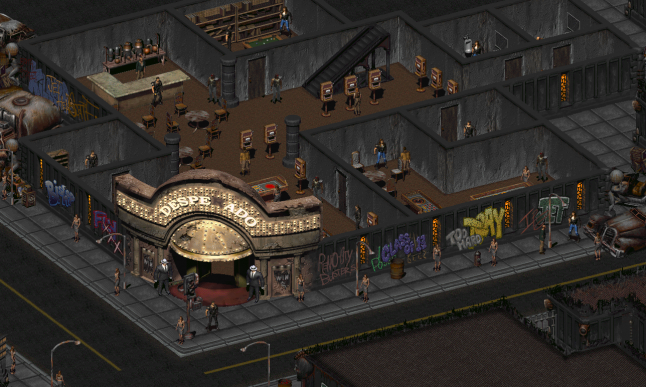
Fallout 2 also cleverly works the skill system into the dialogue, with every stat affecting dialogue choices and results, rather than following the common approach of only checking communication-related skills.
"If you invested heavily in small guns, for example, you might end up using that knowledge to impress someone," says Tomaszkiewicz. "If you know a lot about computers, you could’ve used that fact to reprogram a robot, etc. This use of gameplay-related skills in dialogues and quests was very unique and immersive — something I’d come to expect from a pen & paper RPG, not a video game."
TAKEAWAY: Side quests, like main quests, benefit from an open-endedness that allows for different solutions and playstyles and that ideally also acknowledges all of the player character's relevant skills.
Fallout: New Vegas — consequential and interesting open-world quests
Tomaszkiewicz says that Fallout: New Vegas shares many of the same qualities as Fallout 2, but he adds that its approach to building quests in an open-world setting is also great. "They felt consequential and interesting," he explains, "and yet managed to overcome the difficulties of constructing complex quests in an open world environment. It was a big inspiration for me when working on The Witcher 3: Wild Hunt and its expansions."
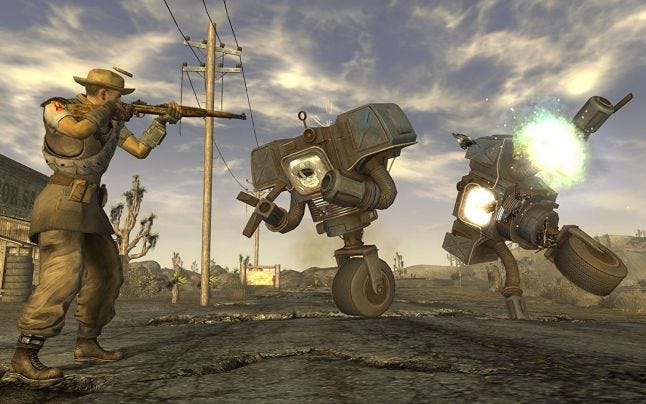
Perhaps the best side quest of the bunch involves helping some ghouls launch a space expedition (or helping to sabotage said expedition) to complete their "Great Journey" to a place far beyond the cruel wasteland. It's a bizarre quest with an eccentric, charismatic cult leader, huge super mutants that can turn invisible (the leader of whom is even more eccentric than the head ghoul, what with him being beholden to the guidance of an antler's skull on his desk), a tech genius human who thinks he's a ghoul, several big choices to make, splendid sound design, and a healthy dose of twisted humor. It's ridiculous, but it's memorable and weighty from beginning to end — as every good quest should be, regardless of its relevance to the main plot.
(Side note: I've limited Fallout's presence here to two games for balance, but every entry in the series is widely recognized for excellent quest writing and design, with numerous side quests worthy of study. Fallout 3's Wasteland Survival Guide is a great tutorial side quest, for instance, while Fallout 4's Last Voyage of the USS Constitution uses flavorful staging and characterization to elevate an otherwise-generic side quest to a higher level.)
TAKEAWAY: Side quests present a great opportunity to flesh out the world building and let the player have a supporting role in the defining moments of other characters' lives, especially in an open-world environment.
Baldur's Gate 2
Wasteland 3 lead designer George Ziets loves it when side quests directly affect the gameplay. "Taking something away from the player (or temporarily giving them something new — especially if the player can gain it permanently later) often makes a side quest more memorable," he explains. "A good example comes from a quest involving Jaheira, one of the player’s companions in Baldur's Gate 2."
The quest begins when a nobleman who wants revenge for being exposed as a slaver places a magical curse on Jaheira — whose stats then get progressively weakened until the curse is broken. "Some designers will argue against the tactic of debuffing player-characters until a quest is completed," says Ziets, "but the gameplay implications of this quest were a huge motivator for me, and it made me genuinely angry at the vengeful nobleman. How dare he weaken a member of my carefully-crafted party!"
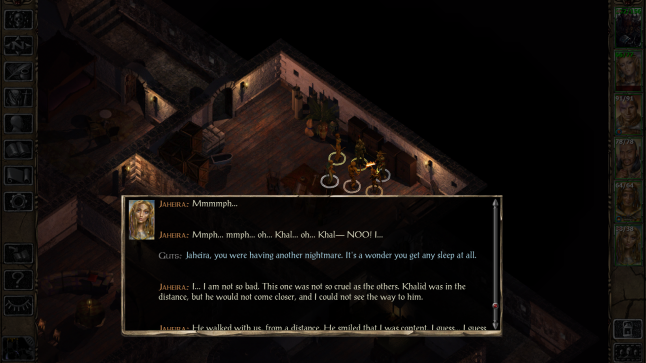
Ziets says that this created a sense of urgency and made the side quest feel much more personal, although he cautions that it's not a design tactic to be taken lightly — do it poorly and players will get angry at the game as much as the villainous characters.
He adds that he believes that side quests should always take an unexpected turn at some point along the way — a view that he attributes to Baldur's Gate 2's untrustworthy NPCs. He cites another example involving Jaheira: first she tells the player they've been summoned to the headquarters of her faction, but then on arrival they're interrogated and sentenced to magical imprisonment — whereupon they must fight their way out. "Later the party is confronted by Jaheira’s old mentor," says Ziets, "who warns her that the other Harpers now view her as a traitor, and she renounces her membership in the faction that has defined her throughout the game. But the quest takes a turn when the player discovers that the local Harpers are traitors, and Jaheira’s mentor has joined them."
Tomaszkiewicz also had great praise for the optional quests in Baldur's Gate 2, singling out two sets of side quests in particular: the stronghold quests, which are tailored according to the player's chosen class, and the Ust Natha storyline, which involves going undercover in the Drow society. He says that these Ust Natha side quests "were built in a way that allowed you to experience how the Drow go about their lives, but [they] gave you options to solve them in a way that would be true to your character."
TAKEAWAY: Some of the most memorable side quests create motivation by threatening something that matters to gameplay or offering an unexpected twist. Others define the quest parameters to according to the player's character stats or customizations.
Gothic 1 and 2 — side quests that build immersion
You could describe the first two Gothic games as being like Elder Scrolls Morrowind set in an intricate fantasy prison, then remade from a fraction of the budget, and while they're full of bugs and design oversights and awkward voice acting, there's one element that they excel at.
Tomaszkiewicz argues that the special thing the Gothic games do — especially the second one — is to use side quests and activities to build immersion. How a player's character develops affects how these optional elements unfold. "For example, there was this tough bully that wouldn’t let you enter the port’s tavern and was pretty hard to beat in the beginning," he explains. "But if you initially avoided the confrontation and then visited him after you became a Mage, his attitude toward you would be completely different — he’d show you respect due to the office you were holding."
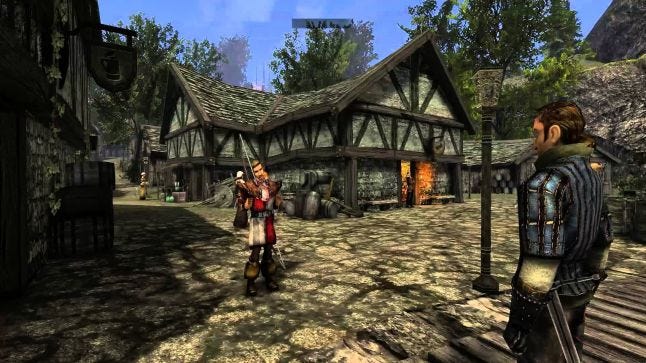
"The game was full of small touches like that, making the world seem more alive and interactive, ripe with possibilities."
TAKEAWAY: The most important function of a side quest is not to keep the player busy or help them grind up their stats; it's to immerse them more deeply within the game.
Planescape: Torment —
No tags.