
Diegesis is a concept created in the Greek theaters that evolved into a modern tool to analyze and create content for any media. Diegetic elements implemented in games increases the player's immersion, taking advantage of the visual language of the game, it's world, fiction and the universe of the character.
First let's go back to the theaters and talk about the Fourth Wall.
The Fourth Wall
Let's Imagine a theater seen from above. The theater has 3 walls, one behind and two on the sides. When Denis Diderot talks about the fourth wall, he defines it as an imaginary barrier that separates the stage from the audience. This wall is invisible looking from the outside in, allowing us to watch the presentation. On the other side of it are the actors, interpreting their characters, for whom this barrier is opaque and completely ignored, the characters are oblivious of the audience and the wall itself.
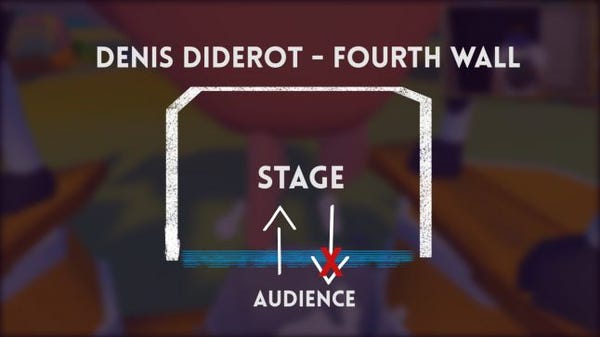
When a character interacts with an audience, we say that he is breaking the fourth wall.
Thus, diegesis is a way to label a game element in relation to the fourth wall.
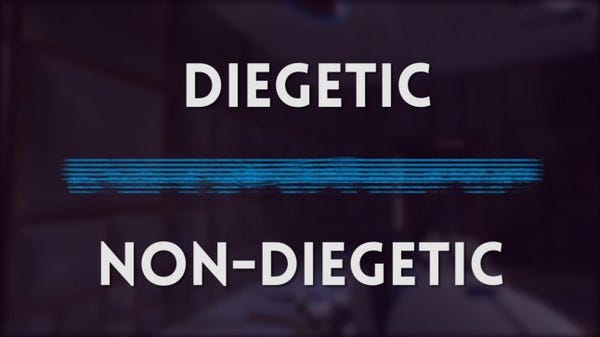
When a character, a song, sound or image exists within the game world, we say that it is diegetic: it belongs to the universe of the character and its located behind this wall. Otherwise, if this element exists only in the player's world, at the other side of the wall, we call it non-diegetic. If it's a menu or an interface element, we may even say that it's hanging on the wall, at the audience's side.
Let's analyze the elements of some games and see where they fit in this taxonomy
Goldeneye
One of the first games I remember having several diegetic interface elements is the Nintendo 64 multiplayer favorite: Goldeneye 007.

Bond's watch, was a mix of pause menu, inventory and mission information. This information is primarily for player consumption but the fact that the character raises his arm and acknowledges the watch-menu as something he sees and which exists in his own world transforms the use of the menu into a character action such as walking or shooting. It also helps that impossible tech built in luxury accessories is a cliché in James Bond stories.
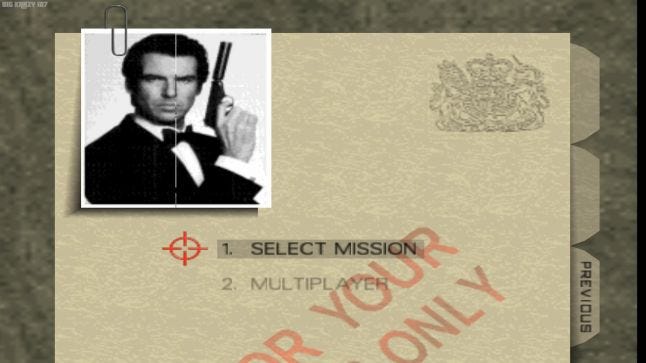
The menus of the game try to get that same feeling. All options are thematically tied with this top-secret-archive look. As if all these options were different documents, and the levels some kind of video in a report file.
Everything clicks so using this menu is no longer a player-only action such as interacting with traditional menus
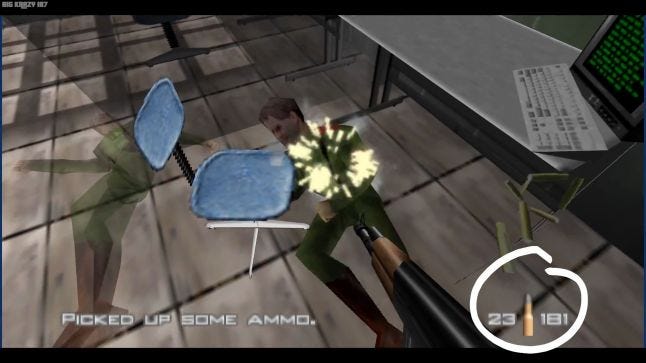
Speaking of traditions, one of the most traditional elements on shooting games is the interface element that shows the ammunition count. This element is an example of a non-diegetic interface necessary for the player to make informed decisions and read this information in a simple and quick way. One must balance the aesthetics with practicality.
Half-Life
Half-life was an innovation in the history of FPS storytelling and narrative, never taking away the player's control over the character and making them see the experience through his eyes. Even at the very beginning of the game, we're free to move and look around while taking that scripted tour through Black Mesa, sinking in the atmosphere

We have other diegetic elements that also make up this immersion: in Half-Life your HUD only appears, showing the amount of HP and ammunition, when you find and equip the HEV suit.
This is Valve's way to acknowledge this information within the game's world, and tell you that your character can see it, just like you, the player.
Overwatch
In Overwatch we have examples where both diegetic and non-diegetic interfaces were used.
In all cases we still have the classic non-diegetic, easy-to-read numbers (for the player) on the bottom of our screen. However, some characters have weapons with a display or detail that shows some of this information to the character as well:
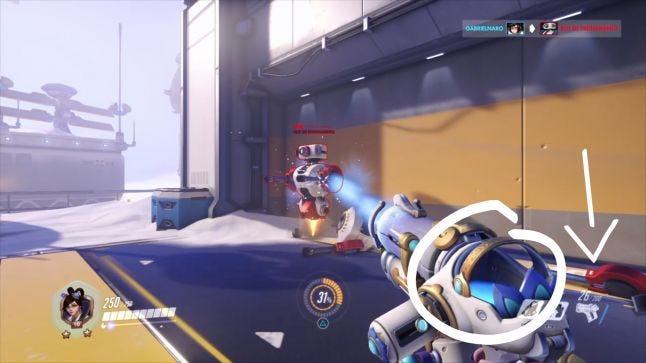
Mei's ice shooter has a visibile liquid charge that depletes.
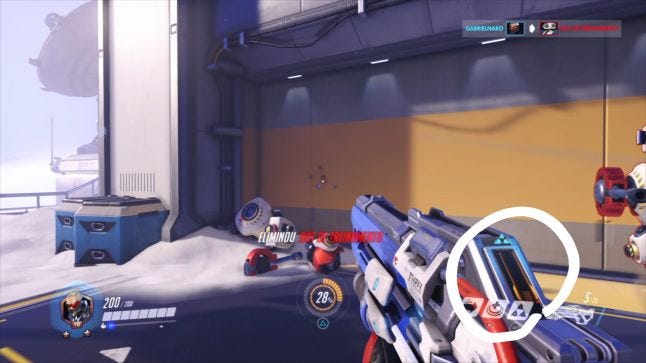
Soldier's weapon shows ammunition and Helix cooldown.
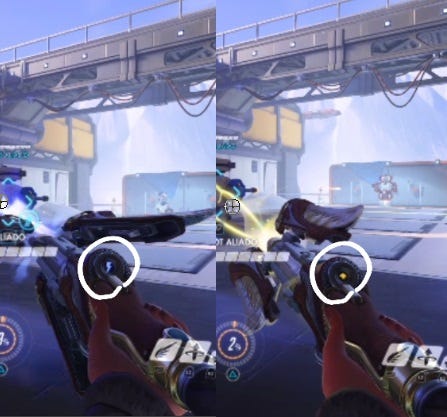
Mercy's staff changes icon depending on the beam.
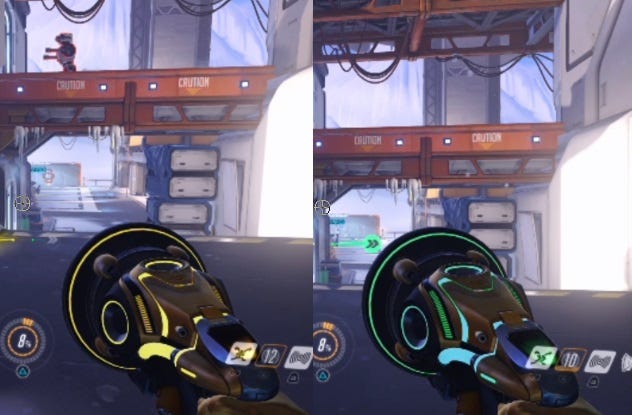
Lucio's sonic weapon changes it's color for each of the active buffs.

Sombra's sub-machine gun has a display to show her the ammunition.
These diegetic elements have two functions in the game: creating more player feedbacks and showing the personality of the heroes. The soldier's weapon represents his tactical-oriented thinking and shows a bit of the character's decision-making process. Contrasting with Roadhog, who puts a lot of iron scraps in his gun and does not care if he has a shot left over or not. The diegetic elements are used to build the characters personality and the world's narrative.
Sound and music are also elements that may exist in either side of the fourth wall.
Portal
At the beginning of Portal 1, when we wake up in our cell, the only thing we hear before being introduced to GladOS is the in-game's radion, which plays for Schell a samba version of the ending song.
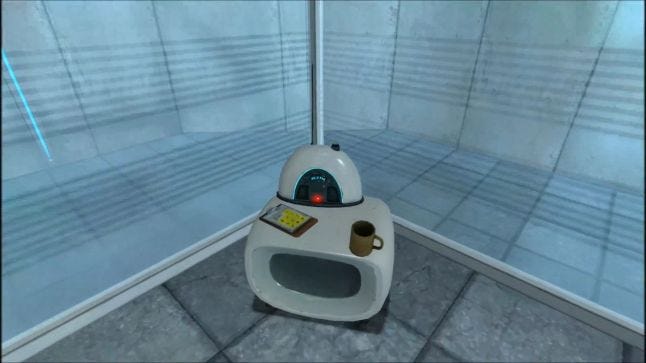
Diegetic soundtracks are somewhat rare, often because the player's movement will reposition them in relation to the sound source. Or simply because it is easily acceptable by the audience and sometimes better for the experience as a whole.
To handle that, designers and directors sometimes use a technique called diegetic switch, as in the ending of Portal 2:
<iframe title="Embedded content" src="//www.youtube.com/embed/wYps-kGPh78?start=171&enablejsapi=1&origin=https%3A%2F%2Fwww.gamedeveloper.com" height="100%" width="100%" data-testid="iframe" loading="lazy" scrolling="auto" class="optanon-category-C0004 ot-vscat-C0004 " data-gtm-yt-inspected-91172384_163="true" id="422800397" data-gtm-yt-inspected-91172384_165="true" data-gtm-yt-inspected-113="true"></iframe>At the start we hear a non-diegetic soundtrack. The song plays for the player, not the character.
This song is interrupted and we are presented with a new song, performed by the iconic turrets, for the character. At this very moment we're listening to the same thing Schell is.
When the elevator starts moving the music gets more distant. That's the rule: if it is diegetic it must exist in the character's universe, and therefore is affected by its physical world.
The apex of this section happens when we have an Opera of turrets playing the whole song. And as we quickly exit the room the song switches to a non-diegetic version of itself, which doesn't lower the volume over the distance.
These diegetic changes, especially with soundtracks, are common in movies and games.
Devil May Cry 4
Another example is the diegetic switch on the intro of Devil May Cry 4.
<iframe title="Embedded content" src="//www.youtube.com/embed/sLFY4tzWUUk?start=510&enablejsapi=1&origin=https%3A%2F%2Fwww.gamedeveloper.com" height="100%" width="100%" data-testid="iframe" loading="lazy" scrolling="auto" data-gtm-yt-inspected-91172384_163="true" id="747699728" class="optanon-category-C0004 ot-vscat-C0004 " data-gtm-yt-inspected-91172384_165="true" data-gtm-yt-inspected-113="true"></iframe>For a brief moment we can listen to the music coming out of Nero's headphones. As soon as he throws it away a non-diegetic version of that song starts playing in the background and the fighting scene begins. This intro also has an instance of Interscene Diegesis where Kyrie is singing in a church, the camera cuts to another place and the music from the previous scene keeps playing normally.
No Man's Sky
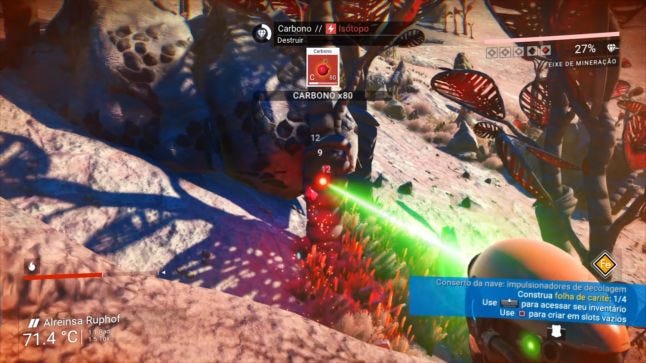
Similar to Half Life, all HUD elements in No Man's Sky such as the charge of your weapons, life support and weather-enduring systems are all diegetic, they are also acknowledged by the game and is actually displayed on the character's helmet. As soon as the player enters his ship, the panels are used to give information about speed, location and fuel, bringing the interface into the game's universe. No pun intended.
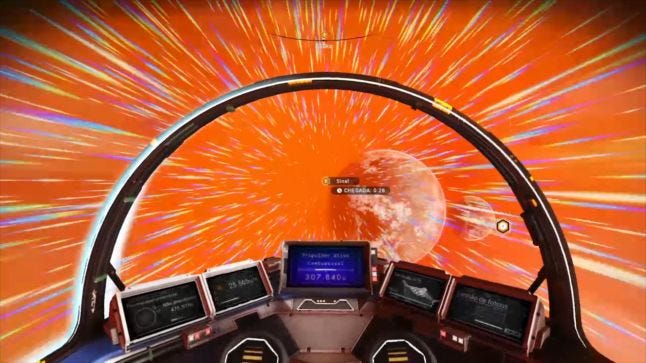
Popup infos like the quest and pause menu maintain the classic aesthetics of menus, and are not diegetic.
Resident Evil 2
In Resident Evil 2 developers had a great idea to disguise the loading screen, which is naturally non-diagetic: using a simple animation of a door opening they could hide the loading and create a big thrill, bringing this moment to the game's world, and keeping the player immersed and anxious to find out what happens on the other side of the door.
 The other interesting element to highlight is your characters' animation when HP drops low. He starts walking slowly, arm crossed, hunched, in pain. A simple way to replace a non-diegetic life bar hanging at the corner of the screen.

Finally, one thing I've always found incredible in the game is the save point scheme. In Resident Evil the saves are diegetic and exist inside the game world as a typewriter. The character may find Ink Ribbon items, which are consumed when the character saves, as if writing a report of what happened until then.

A great way to create tension, taking away the player's ability to save at any given time, in a diegetic and elegant