
Deep Dive is an ongoing Gamasutra series with the goal of shedding light on specific design, art, or technical features within a video game, in order to show how seemingly simple, fundamental design decisions aren't really that simple at all.
Check out earlier installments, including creating believable crowds in Planet Coaster, achieving seamless branching in Watch Dogs 2’s Invasion of Privacy missions, and creating the intricate level design of Dishonored 2's Clockwork Mansion.
Hi, my name is Arnold Rauers and as Tinytouchtales, I've been creating mobile games since 2012. I’m mainly a game designer, but I also do the coding on my games.
Together with various talented people I've released several games, most notably Card Crawl, ENYO and recently my solitaire-style stealth card game called Card Thief. I don’t have a fixed team setup, but I normally work with one artist and one composer on a game.
What: Designing for tension
Card Thief tries to create the experience of being a thief who sneaks into a castle, steals the objective, and escapes the building without being seen. While series like the original Thief or Metal Gear Solid have taken on the stealth genre mainly in the 3D space, I wanted to create a card-based version of the same concept.
In order to create what I think is most important in a stealth or heist game, I designed several game systems that all feed into the idea of creating a high tension experience.
1) The Path
Card Thief’s core mechanic is creating a path through a grid of 3x3 cards. The core action which the whole game is based on is selecting a card that can be connected to the Thief, or the last selected card. Connecting cards is based on a few rules that describe if you can select a card or not.
"The longer the distance you have to travel while trying not to get caught, the more difficult it should become."
While coming up with the concept of the game, I looked at several ideas for how I could represent the sneaking in a stealth game in an abstract way. While thinking about the activity of sneaking itself, I had the idea that the longer the distance you have to travel while trying not to get caught, the more difficult it should become. This idea lead me to the first tension mechanic of increasing the value of each card based on the length of the path / the amount of selected cards per turn.
The idea here is that each card’s base value is multiplied by the current path value/difficulty. Since there a several cards that can either be good or bad, it highly depends on which cards you selected in which order. A card that helps you to increase your stealth is good when it’s selected late in the path. A card that reduces your stealth is good when it’s selected early.
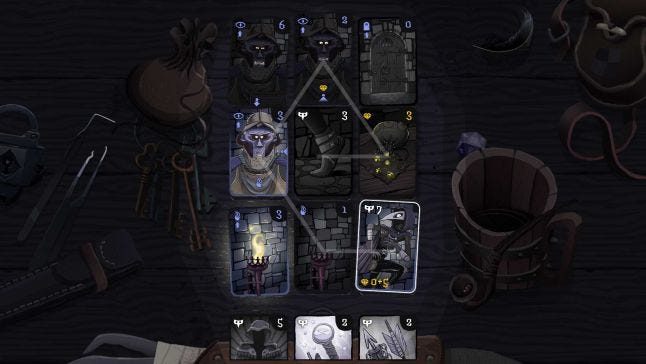
While working on the path mechanic, I felt that I needed to increase the depth of the system itself. In the first iteration, the path increase was only governed by the number of selected cards. But I felt that the position of your thief should also matter.
 Thematically, you could start from a better hidden position and maybe not increase the difficulty that quickly in comparison to worse starting positions. I worked on several iterations of this idea, and finally found a good rule to govern the path value increase. A card that is not adjacent to your thief will increase the path difficultly. This way, it greatly matters on which spot of the board you start the path. While the outer corners will give you the potentially biggest increase of the path value, starting in the middle will not increase your path at all, since all cards are directly adjacent to you.
This mechanic lead to very interesting decisions where in addition to thinking about your current turn, you also have to always think about you next turn, because where you end this turn will influence the next one as well. This increases the tension of each turn quite a bit.
2) Stealth
 Stealth in Card Thief works in a rather simple and abstract way. In other stealth games, your stealth, or the potential of being seen, is communicated in a very analog manner. In Thief, it’s represented through a gem that is bright or dark, in Skyrim, it’s represented through an eye icon that is open or closed. Between both states — completely invisible and completely exposed — there are some more nuanced states that make sneaking around very interesting.
I knew that I wanted a very binary system for my game, where the player always knows what actions will lead to being caught or surviving for just one more turn to get to the next sneak card, or even the exit.
This is why I represent stealth as a simple number, and attached a few simple rules to the detection mechanic.
If the thief is in the shadow,she can’t be seen (Note: This rule is broken later in the game with Owl-Guards). As long as the thief has at least 1 stealth, she is invisible, even when she’s in the light and a guard is directly looking at her.
If the thief has less than 1 stealth and is standing in the light, and a guard is looking in her direction, she will get caught.
"Pretty early on in the game, I decided that the stealth value of the thief should have no restrictions."
In addition to that, if the thief tries to sneak past a guard, and this guard will decrease the thief’s stealth to less than 0, she will as well get caught. This makes up a pretty binary system where you have total control over each move, and are able to anticipate any upcoming threads.
Pretty early on in the game, I decided that the stealth value of the thief should have no restrictions. This ties back into the analogue feeling of other stealth games I described above. Having a clear system on how to lose, which also allows for some faux in-between states.
You always start out with a default stealth of 10, but with clever moves you can increase you stealth way beyond that. On the other hand, you can also decrease the stealth of your thief to any negative number.
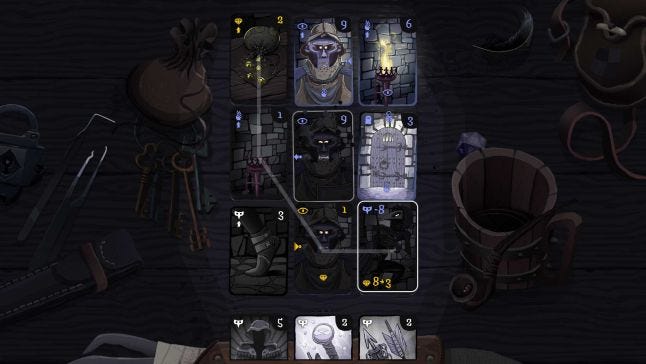
 Each card thief deck contains a bunch of obstacle cards like torches or doors. These cards each have special purposes but also a common idea of not being an immediate threat to the thief. This introduced yet another interesting tension mechanic: Even though the thief is already at 0 or less stealth, she can continue to select obstacle cards and further decrease her stealth to get into a favorable position on the board or hope for the next good card to be dealt.
The more you reduce your stealth, the harder it will become to regain all those stealth points with sneak cards. But finding a Hide card in th
No tags.