
Combat is such a common aspect of many video games that engaging with it feels natural, at least when it’s done correctly.
When you’re hunting down robot dinosaurs in Horizon Zero Dawn or mowing down Nazis in Wolfenstein, it becomes easy to fall into a rhythm. See an enemy in the distance, approach, shoot to kill. Rinse, wash, repeat.
But creating combat scenarios isn’t a matter of putting enemies in the way of the player and seeing what happens. A lot of work goes into ensuring that in-game combat feels natural and fluid or intentionally uncomfortable and clunky. The enemies have to be meticulously planned out and designed, not only because they have to fit the game’s world but also because the player has to have the appropriate reaction to them. In the bulk of instances, the player has to feel comfortable engaging in violence and combat.
Sometimes it’s straightforward. You want to kill hundreds of Nazis in Wolfenstein because 1) Nazis are a culturally-appropriate villainous group of people and 2) because they have their faces covered, taking away any human connection you may have. Protagonist B.J. Blazkowicz wants to kill Nazis because their authoritarian and fascist policies cause the death of millions. But other times, the game is in a fantasy world or for a younger audience not used to violence. So, how do you manage?
Gamasutra talked to a number of designers that have spent countless hours creating enemies for players to kill in-game. What we learned was that it isn’t so easy to throw a player at an enemy. There’s a lot that goes into not only ensuring the enemy is obviously an enemy, but that the player feels safe engaging with it -- meaning there isn’t a lot of empathy and there isn’t any hesitation.
Enemies can’t be “cute”
"They look like something that can mess you up. They look dangerous, and that's intentional. You have to make the enemies feel powerful and menacing."
How do you, for example, create animal-based enemies that feel good to kill? Why do you feel alright killing a wolf or a bear instead of a cute creature like a kitty or a dog? One of the most important aspects of creating an enemy is ensuring that the player doesn’t connect with it through its design.
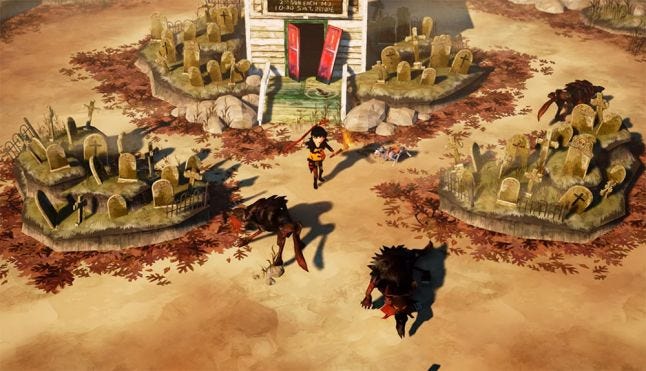
In the 2016 survival game The Flame in the Flood, by indie studio The Molasses Flood, the player has to fight against wild creatures like wolves, bears, and boars as they traverse a river in the American South. Anybody who’s seen the designs from the game can see it wasn’t just a matter of inputting photorealistic depictions of the animals in question. They’re made to look more threatening.
The wolves are especially deformed, with long spindly legs, large sharp jaws, and a guttural growl. They feel more like monsters and less like something only slightly removed from your pet dog.
“They look like something that can mess you up. They look dangerous, and that's intentional,” said studio co-founder and animator Gwen Frey. “You have to make the enemies feel powerful and menacing.”
There are also shapes that tend to be more pleasing to the player, and employing those can make other characters easier to sympathize with. Studies have shown that human brains tend to be more attracted toward round shapes and curves rather than sharp edges. An exhibition from 2013, called “Beauty and the Brain Revealed,” posited that humans are more comfortable around round edges because it reminds them more of how organisms form, so it feels more natural. This is something echoed in character design, where things with spikes tend to feel more threatening.
“‘Safe’ designs usually work to visually convey that if the player takes the chance to fight this enemy, they will win. Round things tend to feel softer, more approachable, where as spikey more jagged things feel more dangerous,” said animator Curi Lagann (who worked on indie titles like Read Only Memories), mentioning the slimes in Dragon Quest as a good example.
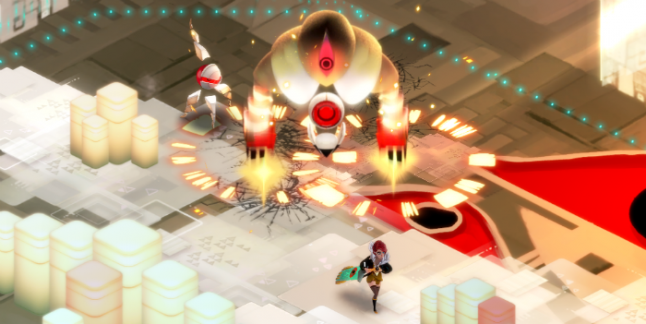
Overall, you can create enemies that remind the player of animals, humans, or other familiar things, but the easiest way to ensure the player has no connection with them is to go in the opposite direction. Developers and designers mentioned that robots (or robot-adjacent creatures) and inhuman monsters make for good enemies because they can be designed to be as unrecognizable as possible. In Supergiant Games’ 2014 title Transistor, for example, the basic enemies are robotic and relatively faceless.
“We wanted players to have starting off having no empathy towards these things. They don't look like they experience pain. They don't look like they have emotion or anything,” Greg Kasavin, writer and designer at Supergiant, told Gamasutra. He added that because Transistor, like a lot of Supergiant games, is morally and narratively complex, Supergiant wanted to remove any ambiguity with the enemies. “There's a lot to take in at the beginning. One thing we didn’t want players to worry about was the morality of these combat interactions. These creatures are clearly on the attack, so it goes without question that they should be destroyed.”
Aliens, zombies, and plants also make for good enemies for similar reasons. You can turn either one into something with a personality or with a face worth sympathizing with, but for the most part, they’re more difficult to relate to physically and personality-wise. Zombies are so popular in games partially because they are devoid of personality or any other features that make them seem human. When the player can’t connect with something on that level, it makes it easy to shoot through hordes of them.
“If the enemy does have a personality, make that personality some variant of "pissed at you,” freelance designer Jalan Ember added. Ember joked that developers can give an enemy “angry eyebrows,” but the idea is there. If there’s something in the eyes or face that looks menacing, then it sends a clear message.
But if a designer is in charge of creating characters that aren’t enemies, the same things must be taken into consideration. Frey previously worked on Bioshock Infinite, creating background NPCs that were separate from enemies. Easiest way to do this? Use children.
“We wanted the background characters to feel human," Frey said. "A lot of times they're children. They'll hide, they'll run, they'll duck, eating ice cream or enjoying their time at the park.”
Sometimes the violence doesn’t have to feel so violent
Creating enemies that look scary is easy enough, but how do you then account for all the games with adorable enemies? The Kirby series, for instance, has the most consistently cute set of enemies and bosses and our bouncy protagonist has to kill or eat them all. How do you get away with that?
"You have to be careful when you're designing where your objective is to harm. You have to be careful not to make the violence -- there has to be intention to it."
Well, the Kirby series is fairly cartoony. Some series, such as Mario Bros., Zelda, and others use combat as a core piece of gameplay, but cut out some of the gorier, more upsetting parts such as blood and visible death. In a lot of the aforementioned games, the enemies “poof” away instead of collapsing to the ground or screaming on the way down.
Feedback puts a wrench in the above section, showing that you can make enemies “cute,” but with added effects. This is usually done in service of a game’s overall tone and as a way to make combat either more or less comfortable for the player. It’s likely to have a game where the point is to kill as many enemies as possible as violently as possible, but that depends on the game and how the devs want you to feel.
“You have to be careful when you're designing where your objective is to harm,” Frey said. “You have to be careful not to make the violence -- there has to be intention to it. The actual violence when you specifically have those hit reactions, it helps to have over-the-top cartoony violence.”
The enemies need understandable motivations to engage in combat
Beyond the look and design, there needs to be a good reason for an enemy to be an enemy. Not only do they need to have motivation to attack the player, but their way of fighting needs to feel natural.
No tags.