
Author: by Arash Hackimi, Saeed Zafarany, Brandon Sheffield
I’ve been doing a research project about Iran’s video games history focusing on how it began, and how it evolved. Through the course of my research I discovered that there were almost no articles in English on the subject, and of the few that exit, none are historical or research-based.
That’s what inspired me to create this document, which should help shine some light on the history of video games in Iran. This is just a small subsection of the larger document I am preparing (in Persian). I thought it would be interesting to compare the history of games in Iran with the recent history of the country itself, pairing important events with events in the video game timeline.
My sources include Persian-language websites about games and technology, physical paper magazines such as Daneshmand, and I also interviewed people I know from the industry, both game journalists and developers. Sometimes I simply trusted my own memory.
The accompanying image should give you a larger context not only for the state of games in Iran, but what was going on in Iran at the time.
Daneshmand is a monthly magazine about science and technology. The first issue of Daneshmand was published in October 1963. Daneshmand is still running today, and is the oldest magazine about science and technology in Iran. For my research I used the magazine’s 50-year digital archive. Unfortunately, there’s no existing online archive for historians to browse, but there is a pack of 6 DVDs that includes every issue from the start of the magazine through 2013, which I used for my research.
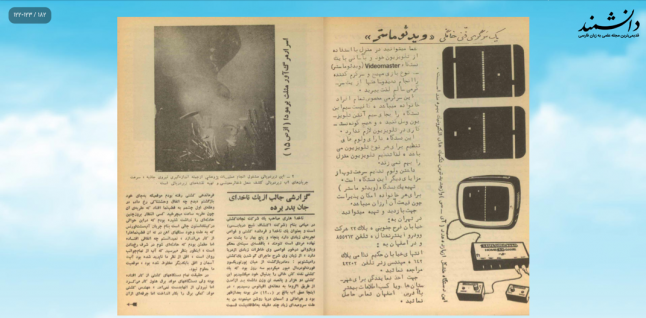
Video Master by Woodrow International in Daneshmand.
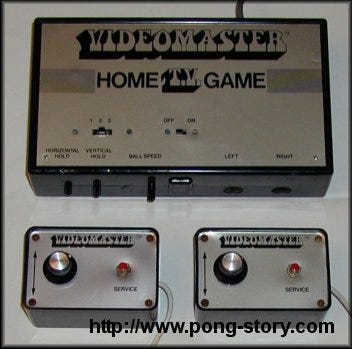
Video Master, via http://www.pong-story.com
Jun 1978, TV Game Released: In its 174th issue Daneshmand reported that another game console similar to the Magnavox Odyssey was released in Iran. The producer of this new console, TV Game, was General Electronic Kit, located in Tehran. The cost of a TV Game set was about 37 USD. Neither Video Master nor TV Game were manufactured in Iran, but they were both assembled there.
Oct 1976, Video Master Released: In its 157th issue Daneshmand magazine published a report showing that a game console similar to the Magnavox Odyssey had been released in Iran. This seems to be the first game console released in the country. The Video Master was imported by a company called Woodrow International, with locations in Tehran and Isfahan. Woodrow International doesn’t exist today.
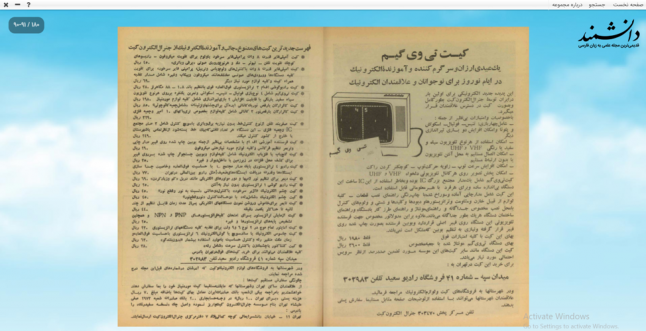
TV Game set by General Electronic Kit.
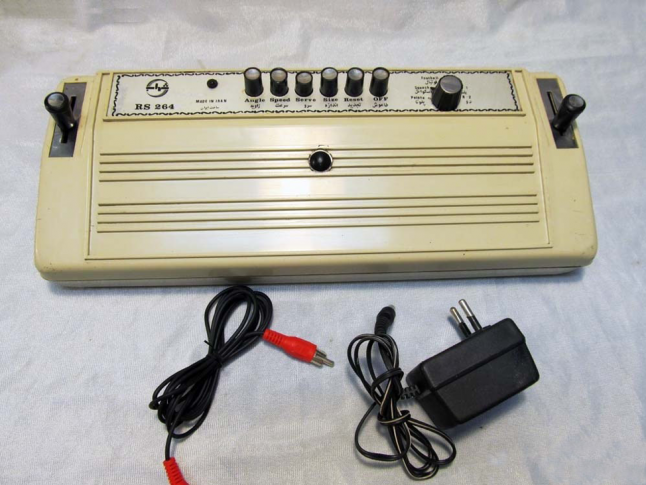
A TV Game set similar to Video Master assembled by Shahab company. Shahab is still operating, and now makes TV sets.
Iran Revolution Succeeded, Iran Hostage Crisis Started, Cultural Revolution Started, Iran – Iraq War Duration: In these periods of time nothing much happened in the fields of entertainment, science and technology. During the Cultural Revolution, all universities closed down for 30 months.
The Hostage Crisis caused the U.S. to break their relations with Iran, and all official imports were shut down as a result. The Iran Revolution rendered most entertainment and even some sports illegal. This includes card games, pinball machines, chess, billiards, golf, bowling, and any kind of gambling. Some ten years later they slowly became legal again, one by one (with the exception of gambling).
When the war began, everything and everyone throughout the nation was called to arms to fight against the enemy. There was no fun to be had during the war until the Atari 2600 arrived.1985, Atari 2600 Came to Iran: This was the first game console which was bootlegged to Iran after the Revolution, and the price was about 120,000 Rl, or more than 200 USD. Since this was was after the Revolution, most of the electronic companies of the past were shut down, and official imports from the United States were impossible (just as it is today). So for many years every video game and computer related product had to be smuggled in.
Nov 1988, First Video Game Reviews Published in Computer Magazines: In its 93rd issue, Elm Electronic va Computer (Electronic Science and Computer) magazine published a video game review. The review covers two Amiga games. This may be the first game review ever published in Iran, and is certainly the earliest that my colleagues and I could find.
When the war ended a flood of entertainment came to Iran, including game consoles, PCs, toys, VHS players, movies, and so on. Almost everything related to entertainment was smuggled in to the country. This isn’t distant history either - most PC parts were bootlegged up until 2007, aside from some Korean monitors officially imported by LG and Samsung and, some printers like HP and Epson. So this review was likely of a bootleg copy.
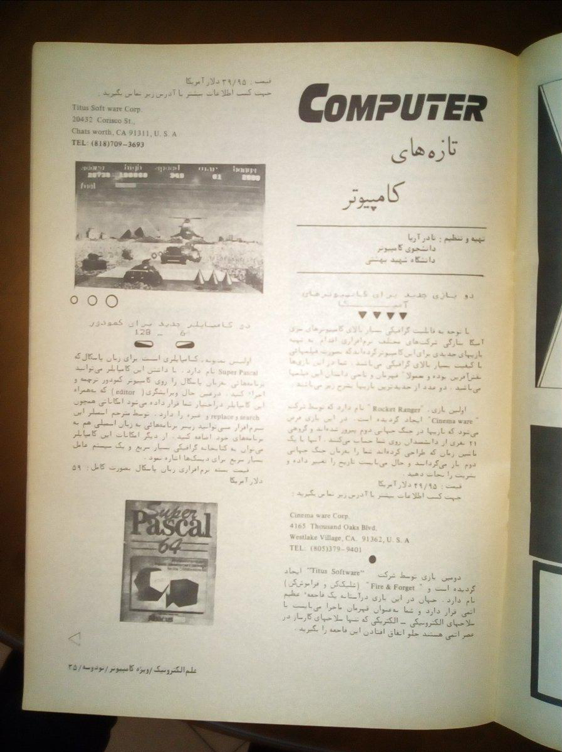
Elam Electronic va Computer Magazine no. 93.
Jan 1989, Commodore 64, Spectrum, Amiga 500, PC, and other Devices Came to Iran: Right after the war ended, even more consoles and other computer devices came to Iran. I don’t have exact dates on this because of the complicated nature of post-war unformation, but I’m working on it. I can say this influx of platforms happened some time between 1988 and 1989.
1992, Micro Genius, a Clone of the Famicom, Came to Iran: As far as my research tells me, there was never an official Famicom in Iran’s market, but a huge number of clones came to the country during the 90s. The first and the most important was Micro Genius, made in Taiwan. After Micro Genius, some infamous clones like Dendy and Super Semtoni became available, both of which continued selling until 2005. During the Micro Genius era Nintendo games became popular in Iran. Mostly Contra, Mario, Duck Hunt, Double Dragon, Streets of Rage, Mega Man, and so on.
But the problem was the cartridges! They were expensive and rare to find. Because of this, people used to exchange their game cartridges to each other (this trend repeated itself with the release of the PlayStation 4). Gamers in Iran had to rely on the pack-in games from their Famiclones for the most part.
Dec 1996, Tank Hunter Released: In the mid-90s we see the first serious attempts at local game development. A game studio was established called Honafa. Honafa was the first game studio which developed a few games for governmental institutions including the Ministry of Islamic Culture and Iran Drug Control Headquarters.
Seyedof, the engine developer at Honafa told me: “Honafa was the first real Iranian game company in existence, and was active for more than 5 years, and developed several finished and polished games.”
Honafa had both a production and R&D team. The production team was busy developing their current projects, since the R&D team was doing research for game engine and 3D technology.
The Tank Hunter was their first release. It was an endless 2D game for MS-DOS in which a man with an RPG destroyed the enemy’s tanks. This game was dedicated to Iranian martyrs and the heroes of the Iran – Iraq war.
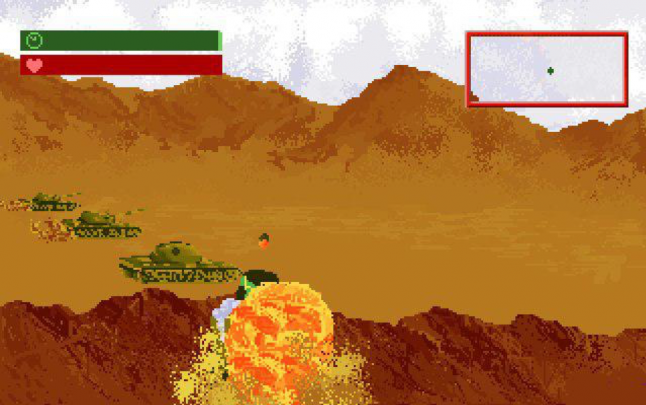
Tank Hunter by Honafa Studio.
No tags.