Another PAX East comes to an end.
I always feel like PAX, more than any other event, shows the trend of the year. Two years ago everything was VR, from student projects to AAA. Then last year, it was all about mid-level publishers like Devolver, Tiny Build, and Raw Fury.
<iframe title="Embedded content" src="https://giphy.com/embed/2cdYOZNTwqb3IbCpPS" height="300px" width="100%" data-testid="iframe" loading="lazy" scrolling="auto"></iframe>PAX before and after
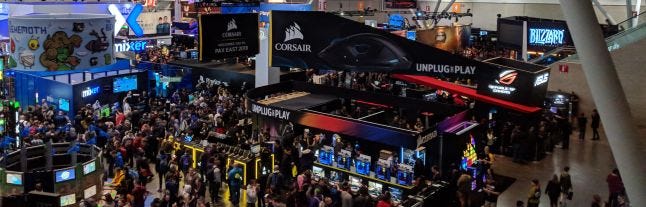
This year, it was all about streamers. So much that it really felt less like a game convention and more like a streamer convention. Twitch was front and center of the convention floor, followed by Discord, and in front of them was Corsair with their ultra neon competitive gaming peripherals (try saying that five times fast). In our own alley, the peeps next to us made clipping software to share gaming moments and the double booth across from us sold gaming chairs.
The single moment that summed all this up: while giving out free handouts to passer-bys, one turned to me and said, “sure, and I have a card for you!”
It was a streamer, The Mofologist.
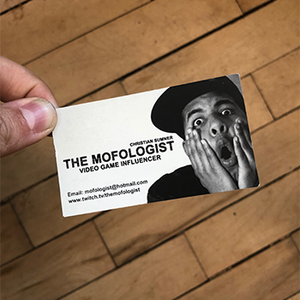
Christian “Mofo” Sumner @Mofologist
It really drove home my thoughts about the convention and the state of games. Game makers aren’t the only content creators anymore. Now we have an ecosystem where we make games for streamers to share with their fans. It’s a new link in the chain. Every developer knows that if you get a big streamer to play your game your sales can spike unbelievably.
Don't believe me? Go ask PewDiePie to play our games ... we'll share the data.
Now those spikes aren’t just bonuses to your release, they are becoming part of the base.
What does this mean for Simple Machine and me?
It means embracing a more open studio. Consistently streaming and taking our social presence seriously. Not just posting to engage, but thinking about what kind of awesome ideas we can bring. We’re not sure exactly what format that is, but after PAX East we have tons of ideas on what we could do.
Pre-PAX Planning
Let’s take a little walk down memory lane and unpack what went into planning our booth this year. We’ll take a look at what worked, what didn’t, and what we learned. Hopefully, by doing this we can give other developers some ideas and inspiration for the future.
I have to say, this was such a remarkable convention for us because it was the first time we had a big plan for our booth. We spent weeks preparing for the lead up to the event, which included ordering branded kiosks and posters, making event-specific builds of our games, and bringing merch to sell!
Suffice to say, despite all the planning we did, nothing could’ve prepared us for how much we learned.
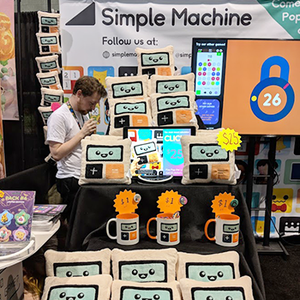
Our booth for PAX East
T-Minus 2 Months
Rewind to two months before PAX. After finding some developers who posted their PAX planning we started a list of things we needed to do to prep for the con. We organized it according to deadlines and divided it into things that needed to be done two months in advance, one month in advance, and two weeks in advance. This helped so much. We never felt like there were a hundred things at to do at once, and instead, we picked out one or two things every week and knocked them out.
We planned most of the design stuff to be tackled two months in advance. Which included things like the background banner, the handouts, and the shirts too.
Then we mapped out the layout of our booth. One thing we did that was really helpful – was getting painters tape and marking out the size of our booth on the floor. It was a small help, and we could’ve tried out more layouts, but we were able to visualize the scale of the items we wanted to put in the booth (TV, tables, etc).
T-Minus 1 Month
A month before PAX, we started ordering the final versions of the designs, any custom booth items we needed (like the big red button for our Pop the Lock installation), and all the merch we were going to sell.


Handouts we made for PAX East
T-Minus 2 Weeks
In the final two weeks before PAX, we ordered little things. A hand truck for loading and unloading our boxes, screen wipes, iPads, extension cords, and surge protectors. Typically at this point, we’d be scrambling to order our background, but thanks to all our prior planning we were able to focus on team needs in the booth for a better experience.
This was certainly not a perfect plan, but compared to our previous years, it was light years ahead of what we’ve done and we felt more prepared than ever.
Setup
You’d think after months of planning we’d have everything set, right?
Nope.
When we arrived at PAX we laid out everything in the booth as we planned it. We set the 65 inch TV centered along the back, then put the table with the big red button in the center directly in front of the TV. Finally, we put the iPad kiosks on each side.
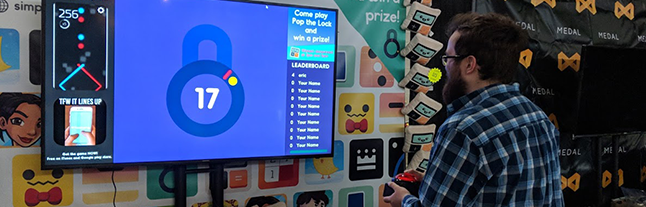
Immediately, we realized there was a problem.
For starters, the table was so far into our booth that people didn’t want to walk in. We could barely get a single player to come in and try it out. So, we tried moving the table out halfway to the center of our booth … finally, some people stepped up to try it out. After a very tiny high five we picked up the table and moved it to the outside edge of the booth.
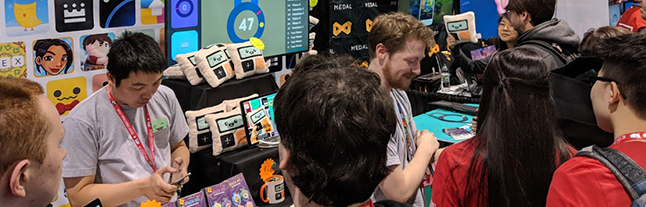
Suddenly a line formed.
There were other benefits to moving the table up too. Before, when the table was right in front of the TV, the player blocked anyone else from seeing what was happening. Once we moved the table up to the front anyone could see the TV from at least two booths away.
Really really good changes.
I get it. Walking into a booth feels like a big commitment. It’s like boom, you’re married! People want to see what’s going on and feel like they can check it out, play, and talk without a detour. I imagine this is super relevant to our catalog of games since Pop the Lock and Calculator: The Game are both really casual. You don’t need to sit down for long periods of time.
The single best thing we’ve ever done with our booth.
We built a custom version of Pop the Lock and put it on a 65 inch TV screen. Throughout the convention, we kept a high score leaderboard and used those scores to run giveaways for free plushies.
<iframe title="Embedded content" src="https://giphy.com/embed/4EFrsAa4dz6I8LnhmH" height="269px" width="100%" data-testid="iframe" loading="lazy" scrolling="auto"></iframe>Screenshot from the custom Pop the Lock build we were running
I’ve never seen a line at our booth, ever. This year, people were waiting upwards of 10 minutes for a chance to play. We showed trailers for our other games on the custom build and automated the high score list.
People came back if they were on the high score list too. Some people even came back multiple days to try to get a high score. One of them actually came back three days in a row and won! By designing an arcade game specifically for PAX, we gave our fans, and ourselves, a fun and engaging way to come together and experience our games.
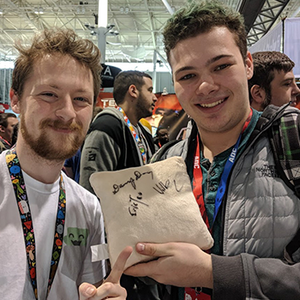
One of the winners asked us to sign his Clicky plushie!
Competition as Connection
It was competitive so players could actually feel a community connection to the game while at PAX. Usually, we just give a player one of our games on an iPad and give them the run down like they’re buying a new car. With this competitive event-only build, players could meet other players on the leaderboard. When a new player was close to reaching the leaderboard everyone would be staring at the game, waiting for it to happen. After they’d make it, everyone would cheer, clap, and congratulate them. There was a real local multiplayer feel. My favorite part was seeing the top players come back when we announced the winners. They’d talk about what it felt like and how hard it was to get a highscore.
It felt awesome to bring people together.
The Spectacle
The other part that really worked was the spectacle. This custom version of Pop the Lock was made for the convention, so we spent a lot of time designing the experience to feel fun, fast, and rewarding. Everything down to the big red button, the branded kiosk, and the integrated leader board were all created so people could crowd around and watch.

Branded Kiosks we ordered for our iPads
It worked.
The top scores showed who was on top, there was an animation when they got on the leaderboard (the lock popped open), and it told players when the winners were announced. We even made room to run trailers for our other games.
Every year our booth gets drowned out and people end up not being able to hear anything. So this year we invested in a speaker that could really bring the noise. You could hear our sound from a few booths away and people bounced to the music as they walked by.
It all came together and was a solid fun experience for everyone who came to play. Our brains are already spinning about what we could do for our other games and how we could use what we learned.
<iframe title="Embedded content" src="https://giphy.com/embed/9XXSAMbljpBX4Cu428" height="300px" width="100%" data-testid="iframe" loading="lazy" scrolling="auto"></iframe>A trailer we made to showcase Pop the Lock
Merchandise
Merch was a new thing for us this year. Previously we would show up with free pins, toss them on the table, and that was that. Think last minute candy for Halloween. This year we brought Clicky plushies (the character from Calculator: The Game) and made plastic wrapped pin packs of our characters from our upcoming Twitter game release.
This is by far where we learned the most.
What Worked
The pins. We had three $1 pins, the Pop the Lock pin, the Calculator: The Game pin, and the Pigeon pin (secret character). We put up a sign for the price, then offered people a pin for free if they had the game downloaded on their phone.
People loved this.
It was great for us because usually we give them away for free and people don’t really care what the pin is. This gave our fans a feeling of appreciation. When they had the game on their phone they were excited to show us and they’d put the pin right on their lanyard. It was also a great conversation starter, people would say “hey I’ve seen this game” and we’d reply, “if you have it downloaded you get a free pin” and their eyes would light up.
Surprisingly, a number of people who didn’t have the game downloaded paid a dollar for the pin they wanted. We also brought pin packs that we sold for $5 each. If someone bought all 4 variants of the pin pack, we offered them for $18. People loved the little characters and since they were based on food, zombies, pirates … that kinda stuff, people didn’t have to know about the game to want to wear them.

The Sandwich pin seemed to be the fan favorite
What Didn’t Work
The characters were not instantly recognizable. The pin packs were from our upcoming game, so when people saw them, they were seeing them for the first time. I’m sure if the game were out and people had downloaded the game they would have recognized them.
In addition, our plushie of Clicky, though super adorable, was from a game that wasn’t as prominently displayed as Pop the Lock. In both cases, we wonder what would’ve happened if say the plushie was for Pop the Lock, so after people played the arcade game, they could take a souvenir. I’m happy we did what we did though. We never expected to make merch and just sell out easy peasy.
We also learned that merch isn’t just about making a thing and selling it. It’s about giving players another way to connect to the game. People love playing the game and they want to show their fandom. Like how you’ll buy anything and everything from your favorite band (did you hear that Flum