Howard Tsao is the founder and team lead of Muse Games, an independent game studio located in New York City that exclusively uses Unity3D to develop across desktop, mobile, and console platforms. Our projects include Guns of Icarus, a bad publisher and hurricane survivor, a multiple award winner, and a cross-platform top-seller on Steam, as well as it's PvE successor Guns of Icarus Alliance. Lately, we're also raising a kungfu possessed hamster beating up vermin to rid a city high on pollen of crime. In addition to making games, Howard serves as an advisor at the NYU Game Center and helps lead an indie dev and Unity3D user group in NYC.
Matthew Hartman is the marketing manager and community manager of Muse Games. He has been part of the team for over four years since the release of Guns of Icarus Online. He graduated the University of North Texas with a bachelors in Public Relations.
Putting out fires, facing dark emotionless directors, and conquering ambition. That’s not only the description of Guns of Icarus Alliance, but the path we had to take to get this game out.
Guns of Icarus Alliance was not a project that a development team would ordinarily choose to pursue. It aimed to balance the creation of something new with the preservation and integration of something old. It was a dogmatic pursuit of an artistic and creative vision and the byproduct of persistence, and the fulfillment of a promise to players and community regardless of the cost in time and effort.
Some people said we were foolish dreamers. Some people said we took too much time, and others said we positioned or messaged it all wrong. The one thing nobody could say, though, was that we failed to deliver.
"We made mistakes, accumulated new knowledge and experiences, and learned a lot."
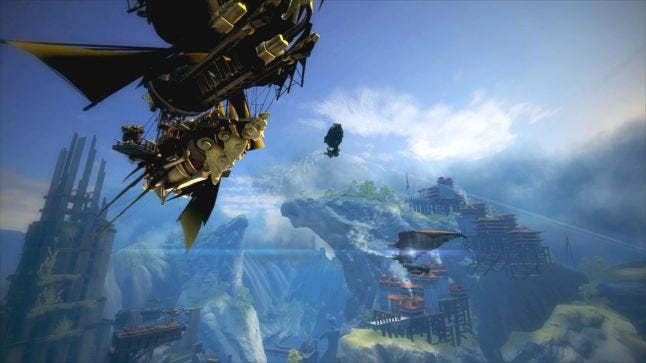
While cooperative airship combat was something we had been dreaming about for years, Guns of Icarus Alliance was officially born from a Kickstarter campaign. We had already delivered the player-vs-player only Guns of Icarus Online, but we wanted to take our steampunk airship idea even further. We wanted to explore multiculturalism and cultural diversity across an entire steampunk-flavored world, craft unique and intense co-op experiences, create a worldview, and deliver more on diversity of combat experiences against variable and intelligent AI.
The vision and promise of that Kickstarter campaign ended up taking three long years to fulfill. In that span, we built complex AI flight, combat, and tactical models from scratch with no previous experience. We also built a dynamic AI director to ensure that match experiences are never quite the same and that AI enemies dynamically respond to player tactics and actions.
We created a faction warfare metagame that allowed us to dive pretty deeply into different cultural and aesthetics influences across the world from mid-1800s to the eve of the Great War. We created brand new gameplay experiences while figuring out how to support our loyal legacy community through Steam, which went pretty far outside the scope of Steam’s backend and support.
Along the way we made mistakes, accumulated new knowledge and experiences, and learned a lot. Here are the key lessons we learned…
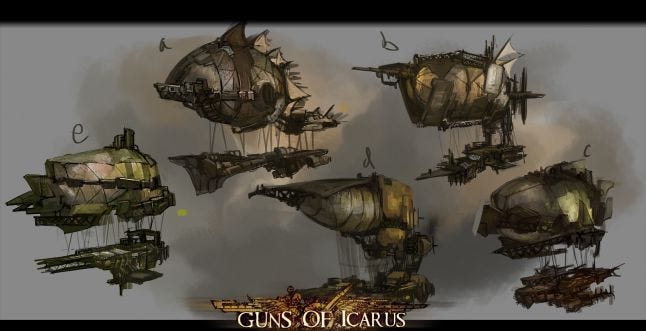
WHAT WENT RIGHT
1) Focus on teamwork and cooperation
Yes, Guns of Icarus is a co-op game, so listing “cooperation” as something we did right might seem like a bit of a cheap shot. Yet, to actually transition from PvP (player-vs-player) to PvE (player-vs-environment) while maintaining the same level of teamwork for a vastly different playstyle was much harder than we expected.
From the very first word of our design, we knew we wanted a game that didn’t just claim teamwork but embodied it in every aspect of gameplay. The pilot can’t fly if the engines aren’t repaired by the engineers, and the gunners can’t shoot if the pilot hasn’t positioned the airship correctly. We wanted our players to truly be a cohesive crew, sharing in the glory of every kill and win.
In Guns of Icarus Online PvP matches the focus is on smaller engagements, so the tactical teamwork and coordination happens across a maximum of eight ships, with two balanced side fielding two to four ships each.
Guns of Icarus Alliance PvE is very different. Apart from the fact that players are now battling against AI-controlled opponents, the balance is also vastly different. PvE engagements are typically asymmetrical to some degree: many weak craft against a few powerful ones, airborne craft against a heavily-fortified defender on the ground, and so on.
Our goal was to create a sense of epic scope – your plucky crew taking on an entire armada to achieve one of a wide variety of objectives – but at the same time we had to preserve that core experience of hyper-teamwork, where everyone is required to work together. We ended up spending a lot of time running countless sessions of player testing; big and small, closed and open.
"The co-op focus in Guns of Icarus Alliance gave us more freedom to create varying objectives."
The balance oscillated between a small number of tougher enemies vs a greater number of enemies coming from more directions. We iterated the design of the boss many times, trying to find a level of difficulty that would require coordination between multiple allied ships without being too powerful. Whenever the testers were wiped out, we had to ask ourselves if they had failed to work together adequately or if the challenge really was too high.
Another major change in PvE was tuning the difficulty to accommodate different levels of player mastery, requiring us to not only tune the various enemy combat parameters but the AI director as well. The enemy spawn rate and the trigger for the mission-ending crescendo event had to not only scale with difficulty but also with number of ships and player crew.
The co-op focus in Guns of Icarus Alliance gave us more freedom to create varying objectives, ranging from base defense to convoy pursuit and search-and-destroy. We also had more freedom to create and design more imaginative and wild weaponry, airships, and abilities. In addition to the stock machine guns and rockets, we now had light beams, Tesla coils, and cavitation weapons, and we added abilities that allow pilots to drift, engineers to deploy drones, and gunners to massively buff weapons. All these elements enabled us to craft a different teamwork experience that is more about achieving disparate objectives and giving crews the opportunity to be heroic during well-planned opportunities and openings.
Finally, we were able to support our more casual players by adding support for single ships, providing an entry point for those who aren’t attracted to highly-competitive play.
2) Honesty and openness with our community
Between weekly posts on development and three streams a week playing with the community and answering questions, we take great pride on being available for players. This effort has been richly rewarded , with players helping us at conventions, donating computers, helping out with a pretty grueling hardcore testing regime, and even writing 11,000 word dissertations of detailed feedback.
We know many of our best players on a first name basis, and quite a few of them have even dropped by our work space. We often spend so much time obsessing about what can be improved or what we did wrong that the simple joy of sitting down with a passionate gamer and hearing how they love the changes to the war system or their reasons one ship is the favorite help keep us sane.
Our openness and dedication also earned us forgiveness for mistakes. Every process would inevitably hit road bumps because we have different constituencies with varying perspectives, interests, and playstyles. Despite these mishaps, our players learned that we really were listening to them, so they would stay with us through server breakdowns and mistakes, trusting that we were working hard to resolve any issues. In fact, we have 1,500 examples of player feedback leading directly to fixes and features. We’ve never had a big player base, so being engaged with our community is that much more important For an online-only game, player base is life. It makes sense to look after them.
3) Our exploration of multiculturalism
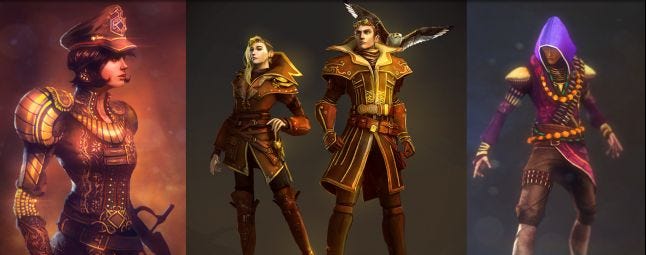
If it isn’t obvious, we love steampunk. It’s an aesthetic that doesn’t get the love it deserves, and when it gets explored (including Guns of Icarus Online) it rarely, if ever, ventures outside Victorian England.
With
No tags.