This article was originally posted on my blog here. It's the third in a series of game design articles about Puzzledorf. You can see the full series here.
Introduction
I don't enjoy playing puzzle games.
A weird thing for someone to say who just released a Puzzle game, but entirely accurate. I've enjoyed the puzzles in Zelda and Metroid over the years, and I enjoy problem solving, but I struggle to think of an actual puzzle game I've enjoyed, unless you count Tetris. Yet, strangely, I enjoy making them. And I do actually enjoy playing Puzzledorf.

When making Puzzledorf, I asked myself a question:
"What makes a good puzzle?"
That question has been in the back of my mind for years while making small, experimental puzzle games. With Puzzledorf, I pursued an answer relentlessly until I was satisfied. It was inspired by the fact that a lot of my friends, who don't like puzzles, found my earlier puzzle games addictive.
I believe I found a solid answer for "What makes a good puzzle?" that works for Puzzledorf. I'm not going to suggest it's the only way to make a good puzzle, but it works, and it appeals to a broad range of demographics and gaming preferences, including people who don't like puzzle games.
This article covers the guidelines for puzzle design I used and why I think it appeals to that broader audience. I also think there's cross-genre applications to some of these ideals.
On-boarding process
Teaching players how to play the game is the first thing to get right. A lot of players, however, hate tutorials. How to teach them without boring them? Or better still, how to have a tutorial that doesn't feel like one?
I use puzzle design to help teach the rules of the game. I talk in depth about this in "Tutorial Design in Puzzledorf", but basically there's only one way for players to move, they can't get it wrong, and I use visual and audio feedback to reinforce when they've done something right.

The physical layout of the puzzle can be used to both teach and guide, without the use of text.
Purposeful Design
I believe this is the most important aspect of Puzzledorf's design, especially when appealing to a broader audience: everything has a purpose. There is no dead space. This, in turn, leads to a players trust. I'll say it again:
Everything has a purpose
There is no dead space
Players trust is earned
I think this sort of purposeful design is critical for appealing to a broad audience. There are a lot of people who don't like puzzles because they think they can't solve them. When you earn their trust, they feel motivated to play through your game.
What do I mean by dead space? Anything that isn't part of the solution. I'll give you an example from one of my early Puzzlescript prototypes (Puzzlescript is a great prototyping tool with limited graphics). The goal in the below puzzle to is to get the orange block on the left onto the orange cross. The two blue blocks are just obstacles to move out of the way.

This was an early level design. There were a lot of spaces you could avoid and still solve the puzzle. They were intended as distractions from the real solution. I thought that was clever at the time, but I have since found that kind of design hurts the relationship between players and my puzzles, and can negatively impact their trust in my puzzles as well as their confidence to solve them.
The puzzles solution is demonstrated below.

Next, below in red are the parts that I consider dead space, ie, not part of the solution. The ideal solution does not use those spaces at all.

If I were to redesign the puzzle now, it would look like this:

Because there are now no distractions, the brain can immediately see possible solutions. This, in turn, is more inviting for players to have a go, particularly newcomers to puzzle games. When the brain thinks it can see a solution, players can't help but act. And mistakes feel less frustrating because it's easier to see other possible solutions and "have one more go."
When you design puzzles where everything has a purpose, in time you earn players trust. I distinctly remember one player saying to me,
"When I realised that everything had a purpose, I started to play differently. It made me wonder how to use each space. I started to trust the puzzle."
This friend was a game designer and the feedback was completely unsolicited, he just blurted it out while playing. Being a game designer, he was able to put into words what he was feeling, and it's been an extremely useful guideline ever since. It's the kind of reaction I was hoping for, but to hear someone say it unsolicited was an immense reward and confirmation of my decision to use purposeful design.

Now don't get me wrong, the original prototype was fun and a lot of people enjoyed it. But the new style, where everything has a purpose, appeals to more individuals and players find it harder to put down.
Caveat
It's possible to think you've designed a puzzle where everything has a purpose and there's no dead space.
Then one player breaks it, finding a solution you didn't think of. That solution ignores part of your puzzle, meaning you accidentally created dead space. That's okay when that happens - you still had a purposeful design and that's what counts. You can't see every possibility. The question you then have to ask is, "Is the puzzle broken? Or was this just an unexpected but fun event?"
If everyone skips your ideal solution, maybe it is broken and needs tweaking. Or, maybe it's just fun that the player found another solution.
I find it fun to see players find solutions that surprise me. I then consider if the puzzle needs fixing, or if it's a rare occurrence and to leave it alone. It's a case by case thing and it's impossible to see every solution.
Complexity
This is probably the hardest aspect to get right, but incredibly important. What's the right level of complexity? And the best way to increase difficulty?
My first puzzle game was made in Puzzlescript, which is a fast prototyping tool but has limited graphics. My way of adding more difficulty was to add more stuff to interact with, more blocks to push. With one of the later levels (pictured below), multiple people gave up when they saw it, without making an attempt.

I decided, after much testing, there was too much information for the player to take in, and they got overloaded. My discovery, for the average player, was this:
If player's cant take in the problem at a glance, and see a possible solution, they get overwhelmed.
Some of the more veteran puzzle players saw the complex puzzles as a challenge and plowed through them, enjoying them. But the majority of my testers weren't "puzzle gamers", and they got overwhelmed by puzzles that were too complex.
What I came to realize was this:
It was not the difficulty that scared people off, but having too much information to take in at a glance.
That information overload switched peoples brains off. When they looked at the puzzle, they didn't know where to begin; they couldn't see a clearly defined problem to solve, or any potential solutions, so they gave up. A lot of these people then walk away thinking they don't like puzzle games, when in fact the puzzle itself was at fault.
However, when you reduce the complexity, the problem that the player has to solve becomes clearer, and they are more likely to embrace the challenge.

Eventually, as I tried different approaches, I realized Sokoban games (block-pushing puzzles) have a number of puzzle-solving techniques. By isolating these techniques, and trying different combinations, I discovered I could manipulate the difficulty of the puzzles without adding too much complexity. I could make puzzles that looked simple, but were difficult.
I found the following to be true:
A puzzle that looks simple, but has a surprising solution, is deeply satisfying.
I discovered my puzzles appealed to the broadest audience when I did the following:
Reduced the number of moving parts
Created puzzles that looked simple
Difficulty increased through harder puzzle solving techniques, and different combinations of techniques
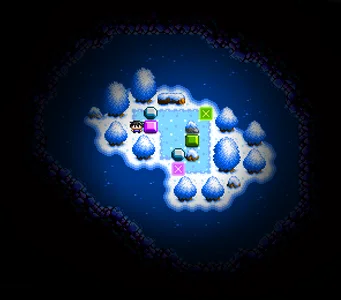
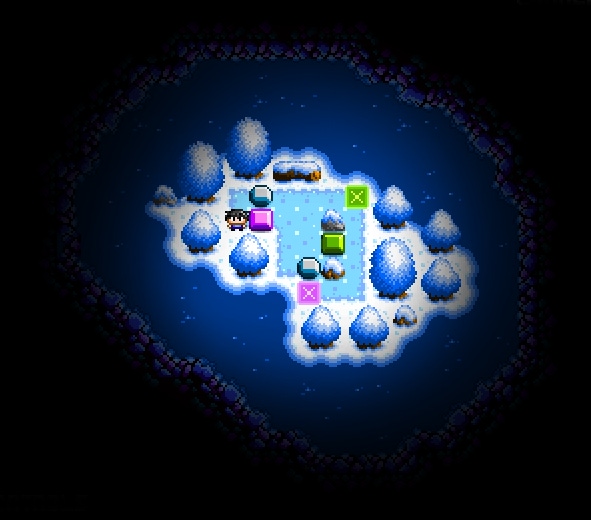
Below is an example of a later game level from Puzzledorf that looks simple, but is one of the harder levels in the game.

It Looks Easy, But Surprises you
I found the following to be true:
When a puzzle looks simple, the brain sees possible solutions