
Author: by Bruce Brown, Peter Chapman
Presented by Amazon GameLift. Learn more about cross-platform game development during our live webinar. Register today!
Development of multiplayer games has reached an inflection point: game developers have started supporting cross-platform play across all devices. This is a significant shift that can create better player experiences while introducing new challenges for game developers. What makes this new development in cross-platform play so significant is that it challenges some long held beliefs and assumptions in multiplayer games:
Players value competitive fairness of matches over being able to play with friends
Mobile games can’t meet the same performance expectations as PC and console games
Certain genres – like shooters – don’t translate directly to mobile
Players only want to commit to playing a game on one gaming device
Why should you consider supporting cross-platform play for your game?
It’s all about the players. Players can now play with their friends who are on other platforms without having to buy another copy of a game or invest in an entirely new gaming device. They can engage more frequently with a game across a number of screens throughout the day: on the bus with a phone, at lunch on a laptop, at home on a PC or console, etc.
Wait times go down and the competitiveness of matches go up. Combining all players into a single large pool allows matchmaking logic to handle where players intersect across gaming devices. Players willing to opt-in across multiple gaming devices will find matches more easily, and with a larger pool of players to choose from, the likelihood of finding matches with similarly skilled players increases.
Build and manage a single community of players. Cross-platform play eliminates the inherently fractional nature of isolated gaming devices and brings all players together to play, creating stronger and more loyal communities for game developers. And you'll likely increase MAU and profit.
Simplify your backend infrastructure. With the right architecture, cross-platform play can simplify the backend services infrastructure around getting players matched and into games.
This last point is what we are going to address in the remainder of this post by walking through an example using Amazon Web Services (AWS) and Amazon GameLift, the dedicated game server hosting and matchmaking solution.
How to design and support cross-platform play
Requirements for designing cross-platform play architecture
To get into the specifics of how your game can support cross-platform play on AWS, let’s explore the requirements of an end-to-end solution:
Accept game requests from desired gaming devices such as Xbox, PlayStation, Nintendo, PC, Mac and mobile devices.
Capture the device that the player is playing on
Allow players to opt-in to or out of cross-platform play
Capture player data for matchmaking such as skill and desired role
Match players into games based on your defined rules
Route player groups to a suitable game server for play
Figure 1 (below) shows a multiplayer back end architecture that supports cross-platform play.
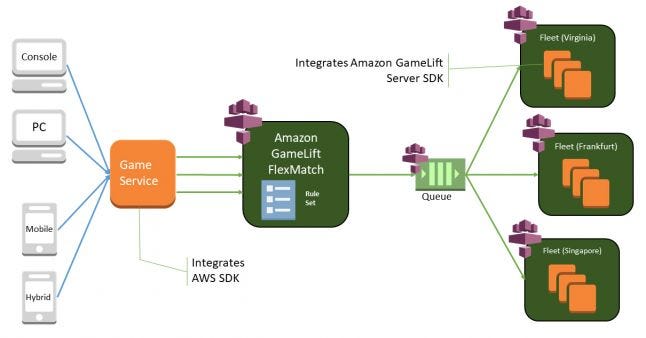
3 steps to implement a cross-platform play solution:
Process requests from multiple gaming devices
Match players across devices
Place players onto game servers
Let’s take a closer look at how to achieve these three steps.
1. Process requests from multiple gaming devices
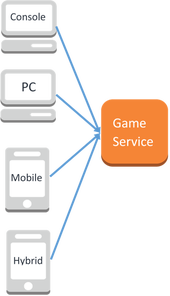 First, you need to accept game requests from players on any gaming device the game supports and use the data from those requests to generate matchmaking requests.
In our multiplayer backend service architecture, we have a game service that acts as a front door to game clients. The game service is a custom part of the e