

Far: Lone Sails is a game of curiosity and exploration.
It's also a 2D game chiefly concerned with moving from the left side of the screen to the right, which means the Lone Sails devs had to get creative in order to spark the player's curiosity.
Released earlier this year by Okomotive, Far sets the player free in a dried-out world with a huge mechanical vehicle they can use to traverse it from left to right. To give players a sense of worlds to be explored and stories waiting to be told, Okomotive had to do what the best it could with what was available: the look and feel of the wastelands that players traverse.
“The unknown areas which lie ahead create a lot of curiosity for the player and with that the motivation to keep driving," says Okomotive creative lead Don Schmocker. "You can’t see much of what’s coming up. It’s like opening a wrapped present, and it was very important for us to build up excitement and to deliver a surprise without disappointing the player,”
Not that all exploration is outside of the vehicle on the drive, though. Like taking a road trip in a stranger’s car, a part of that sense of learning about a place comes within the ride itself.
Side-scrolling exploration
“There are two forms of exploration in Far: Lone Sails. One of them is the exploration of the world passing by in the background. The player can’t interact with it, but the environment gives hints as to what happened in the past. These hints have a certain continuity throughout the game," says Schmocker. "The other form of exploration is happening on the layer where the player is active. Due to the 2D restrictions the room for exploration is obviously limited and consists mainly of driving to the right and finding out what’s ahead of you,”
"[Exploring the unknown is] like opening a wrapped present, and it was very important for us to build up excitement and to deliver a surprise without disappointing the player."
Left to right movement in a 2D world doesn’t leave as many places to wander as a 3D plane might. There’s no nooks and crannies to hide things in, and no ability to turn the screen and find yourself looking at some mysterious structure in the distance. That doesn’t mean you still can’t hint at that intriguing place, though, using a distant background to project where the player will go next.
“What certainly helps is that some objects in the background are visible from a great distance. It takes a while to see them fully and from different angles, while driving forward," adds Schmocker. "It was important to reward the player with information and a beautiful or impressive view, which most of the time will be announced before the player gets there. For example, you see a billboard with the picture of a village and some moments later you drive and progress through this village,”
Here, Okomotive turned the weak point of a strict left-to-right 2D plane into a strength: rather than just hope players discover things that are narratively important or interesting, Schmocker could precisely time when these discoveries would appear because he knew exactly when the player would reach them.
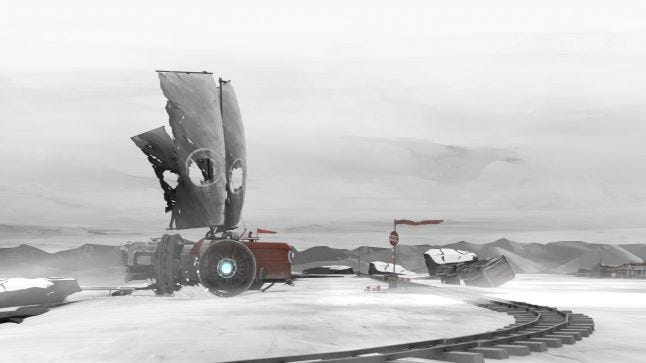
“You have greater control over the general composition of the visible area and the timing of certain objects appearing,” says Schmocker. “With this, it’s easier to create emotional moments for the player.”
And so, despite not having much (or really any) spoken dialogue or written narrative, Lone Sails is capable of conveying a very specific story with narrative arcs by guiding players past something as weighty as a broken-down city or as seemingly innocuous as a road sign that teases a future location. The player sees it at the exact moment the developer wants them to, which means Okomotive could carefully tweak the resonance of a moment rather than leave it in to be stumbled across it at some point of the player’s accidental choosing.
“We use a few methods to create these leads," Schmocker continues. "Usually there is a notable transition from one area to another, like an increasing amount of houses to announce a settlement. Another tool was the use of pipelines, railways and roads. It’s intuitive to expect that they are leading somewhere [important] and in the game they do in all cases. Designing a linear hand-crafted experience like Far has the inherent advantage of rarely having to use the same hints twice. So, the chances of the player learning what to expect are slim."
A key, if easily overlooked, element of Lone Sails' environmental storytelling is its dynamic camera system, which is yoked to the main character.
“In comparison to similar games like Inside, Far: Lone Sails has a dynamic camera distance. This distance depends on the speed of the vehicle, whether the character is inside or outside the vehicle, and how far apart from the vehicle the character is,” says Schmocker. “We wanted to have the character, the vehicle, and all the interactive objects, on the same visual layer. That means, everything on that layer had to be traversable, movable or destructible. Every building had to be built with enough room for the giant vehicle to pass through or small enough to destroy it.
"However, this perspective made it more difficult to see what’s further ahead on the road," Schmocker adds. "To solve this, the camera zooms out and moves slightly to the right when you are driving."
This change in perspective also seems to flow from that road trip mentality – the moment when something so captivating causes you to stop the car and look at some striking vista or oddity alongside the road.
The two perspectives, which are useful from a play perspective in order to keep the player from having too limited or too broad a viewpoint between the huge vehicle and their tiny avatar, also lets players take further or closer looks based on where they’re standing. It also encourages the player to ‘pull over’ and take a look at something, to stop moving as well as see it from a different, closer perspective.
Not that this didn’t result in some troubles to be worked out, as players can hop in and out of the vehicle at any time, forcing a bit of extra work on Okomotive's part to make all viewpoints viable at all times.
“This creates some very nice compositions and helps the player to navigate the game world, but at the same time it reduces the control over the viewport," says Schmocker. "As a consequence, we had to design every area with both minimum and maximum camera distance in mind."
Vehicle exploration
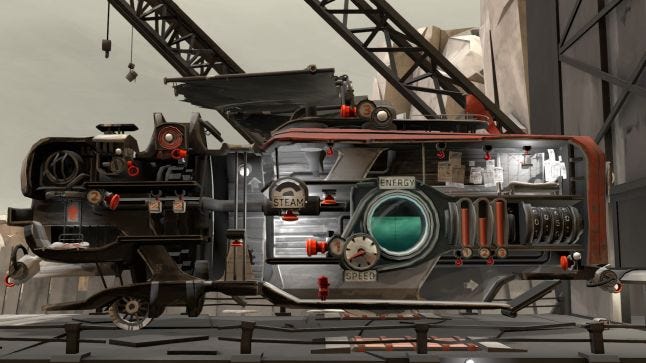
Another key part of evoking Lone Sails' atmosphere of exploration and curiosity is the strange, almost Goldberg-ian machine that players must learn to pilot and maintain if they want to survive.
"The vehicle came first and everything else followed."
“We wanted to let the player discover and explore a functioning vehicle without them knowing how it works beforehand,” says Schmocker.
The huge vehicle players drive throughout Far: Lone Sails is a complex machine, with many odd mechanisms required to keep it moving -- mechanisms which were challenging for Schmocker to design in a way players could master over time.
“It was very risky to have something potentially overwhelming so early in the game and it was a long road to balance the difficulty,” says Schmocker. “We play-tested it a lot from very early on and went through many iterations to make the mechanics more self-explanatory. Also, having the vehicle gradually expand its functionality over the course of the game certainly helped in making it not too overwhelming right from the start.”
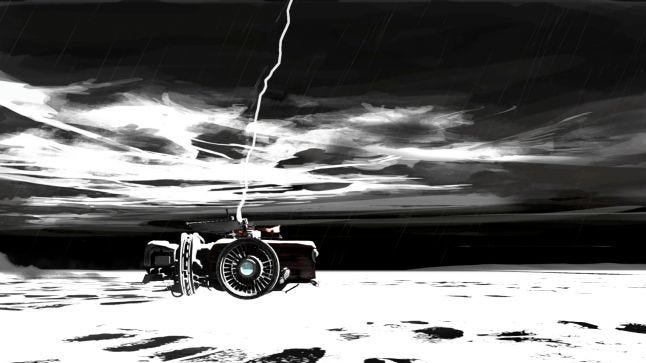
Thus, both the outside world and the inner workings of the vehicle give players room to explore and learn. To keep their landship moving forward, Lone Sails players have to explore its guts and play around with them, finding marvels in their own forward motion. To this end, Okomotive tweaked the vehicle’s design to draw the eye, or hint at some functionality the player might not immediately expect.
“The player has to figure out how to refuel and start the engine," says Schmocker, who previously
No tags.