
Gamasutra staffers recently had the pleasure of talking to Harvey Smith of Arkane Studios while livestreaming Dishonored: Death of the Outsider, the well-received standalone followup to Dishonored 2. Smith's comments about the design of various features in the new game, and in the franchise more generally, were fascinating. So fascinating that we decided to transcribe portions of the stream.
Read on to learn about fascinating features that were cut for the game, as well as Arkane's approach to playtesting, whiteboarding, and designing powers.
And for more developer insights, editor roundtables and gameplay commentary, be sure to follow the Gamasutra Twitch channel.
STREAM PARTICIPANTS:
Harvey Smith, creative director of Arkane Studios
Bryant Francis, contributing editor at Gamasutra
Alex Wawro, editor at Gamasutra
On designing Semblance and the other powers in the Dishonored series
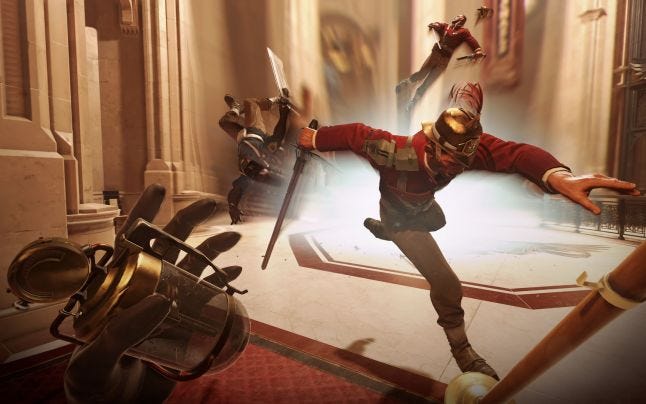
Wawro: There's a power in there called Semblance that allows a player to adopt the visage of an enemy, and that seems like a huge deal for me, as someone who's played a lot of these games, and is constantly trying to stay out of sight, that you can do social camouflage. It seems like it has a lot of interesting ramifications for how you design levels. Is that on point? Can you talk for a bit about that came to be implemented and what challenges it brought?
Smith: Any time someone asks about Semblance, I have to say a couple of things. One, the way it came together was amazing. Earlier Jerome Brown, one of our senior games systems designers, thought about how many pieces had to come together for Semblance to be as cool as it is, from the effects, to animation, object design, narrative design, level design, the programming overall of it, the sound as you take someone's face, it's all in symphony. And the other two things, I have to say it's the power I was most dubious about.
"So many pieces had to come together for Semblance to be as cool as it is, from the effects, to animation, object design, narrative design, level design, the programming overall of it, the sound as you take someone's face, it's all in symphony. "
Early on the game design team pitched a couple of ideas, and they always come from the team in different pieces, and even if you pitch something, someone else makes it better by suggesting something else, some constraint or whatever. We were kicking around the powers, we were about to start prototyping, and people really wanted to do this identity-stealing power. And I was so dubious.
We've seen Hitman, you can take hostages, Corvo possesses people and you can walk past their allies. We've seen variations of this off and on, and it has these problems. Invariably there's some situation where you take someone's face and you walk in and talk to their husband or wife or best friend, and they don't quite respond right, and it lets you peek behind the curtain. The illusion is broken.
But the team was so convinced, they were so passionate about it, kept working on it and adding constraints and rules. The level and narrative designers signed up for the challenge, and they just did a really good job of supporting it, to such a degree that it surprises me.
I was telling this story the other day, there's a level later where you revisit the Royal Conservatory. Months have passed since Dishonored 2, the lighting is different, a different faction is living there, it's been updated in architecture. But you go back to this known location in Karnaca, and a major scene plays out at some point between two of the major characters, and one guy is working at the vivisection table, and he keeps working and keeps muttering and talking, and she comes back to the door, and she's not going to wait much longer he'd better get a move on, and he says yes yes, I'll be there in a moment. I thought, what if I took him out, take his face and went to the intended meeting with her, if she'll respond?
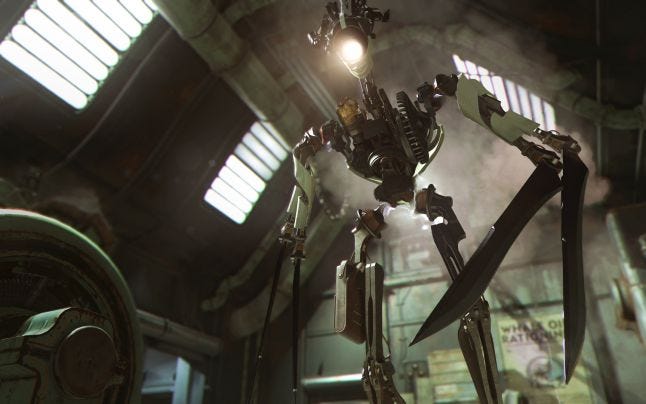
And so he did, he cleaned up and started to head out, and so I choked him out and took his face and walked in and talked to Sister Rosalind, and it all worked. And I was like, wow, people went further on this feature than I thought we were going to. That's the first thing that comes to mind, this is a feature that people on the team really believed in and went the extra kilometer to make it work. We keep getting feedback that it's one of the features that people are really having fun with.
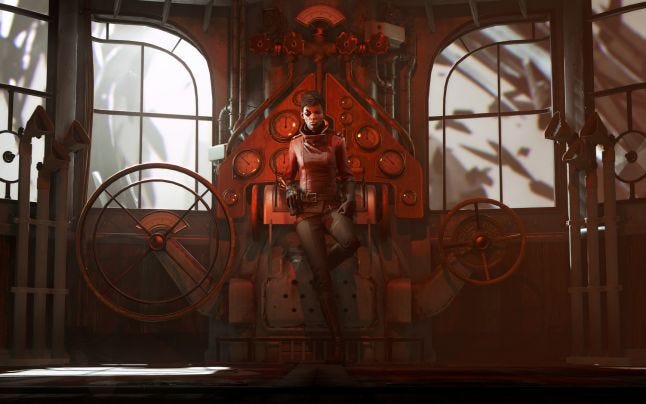
What we tried to do with Billie, early conversations we had with Dinka, we really tried to make this less of a game where you could stab people or throw fireballs. Instead you have to get in someone's face. You have to physically cross the space, or get behind them, or get close enough to eavesdrop on them or listen to them, it's very visceral.
And so powers like foresight, it's my favorite vision power that we've ever done in a Dishonored game, because it's so much more active, in a way? It doesn't let you cheat. You stop time, you kind of astrally project, you see Billie leaving her body behind, you ghost around and scout where the objects are and where the guards are at, then you snap back to your body and it picks up from where it stops. Anything could happen at that point. The guards could actually turn from where he was going, but you have a glimpse of what he thinks is going to happen.
That's why it's called Foresight. It's just an example of a very active, visceral power. The same is true of Semblance, we just tried to err on the side of making you play the game. Powers aren't so much a "smart bomb" in Billie's case, they're alternate ways to play the game.
How Arkane handles playtesting
"When players are lost let's not do the most obvious thing, let's don't just put a marker to whatever. Let's try to find a little thing that guides them in the right direction, or that draws their eye."
Smith: Arkane believes very much in iteration and playtests, so, constantly, the producers are organizing playtests where we're bringing in people, we're watching them play, very often they're streaming to every single developer in the building's monitors. So they'll be working through the day while they have this going on on the right. We have guys like Christophe Carrier, level design director, who will later go get all the videos from the playtests, in our labs, and watch every single video and make notes.
That's above and beyond, I don't do that. I used to do that, I mostly get an aggregate sense of what everyone is feeling now. But Christophe still does that, and it's really useful. Where people are stuck, where they're lost. When players are lost let's not do the most obvious thing, let's don't just put a marker to whatever. Let's try to find a little thing that guides them in the right direction, or that draws their eye. Then let's do another round of testing, and if people are still not getting it, then let's go stronger. It's part of our values to try to give you the experience, to let you discover it, to let you explore it.
When Arkane commits to ambitious features, and when it decides to kill them
Francis: We've talked about making these kinds of games, about making these intricate features that take a lot of resources that wind up defining the games. You've talked about being scared of these features, how there's something really intense that you know is going to take up a lot of resources but could be totally awesome and really hard. Can you walk us through, where's the point where you realize it's worth over-committing to this path, if you will, sand out those edge cases, to build that extra logic, to create the scene like the one you described earlier regarding Semblance. Walk us through that process through which a feature becomes really killer, or you have to walk away from it and kill your baby.
Smith: So this is a good example, this guy's painting here in the stream, and you get the sense that he works around the corner. If you just walk around the corner there are some dogs that are hostile to you. But as long as you're him, while you're using his identity, the dogs shouldn't react to you. But that's a case where Foresight would have helped you, could have zipped around the corner. Billie also has a talisman called Rat Whispers, where you can listen to what the rats think, they've seen things.
It's just part of our DNA, based on the kinds of games that we love, that we have faith that if we put all the detail, all of these alternate ways to do things, all these little improvisational tools into the game, that some percentage of your players will find them, that they'll have a "magic moment," and that's constantly what we're going for.
"Those unpredictable 'magic moments' are really why we play games. That carries the whole team at Arkane along, knowing that that's the kind of experience that we're providing people."
By "magic moment," I don't mean that we scripted the perfect moment here whatever, I mean like we get some unpredictable point for us along the way, and different for every player, there will be some moment at where you use the power at the right way that you narrowly avoided some situation that felt very dynamic, that felt systems-driven. A guard happened not to notice you because of a sound you made earlier, he turned in a different direction. That's really why we play games, looking for those moments, and so it's that faith, I think, that carries the whole team at Arkane along, knowing that that's the kind of experience that we're providing people.
The downside to it is, it really really works on certain types of players, and it really doesn't work on other types of players. And so there are people who are
No tags.