
This article is reposted from Karin Cederskoog's personal blog. Visit the original post for a more formatted version.
Karin Cederskoog was a former AI Design Intern at Avalanche Studios, who worked on theHunter: Call of the Wild. This blog post was published with permission from Avalanche Studios.
Introduction: theHunter: CotW - The Most Realistic Hunting Game Ever
 Prior to working on theHunter: Call of the Wild (CotW), the closest I ever got to hunting was skeet shooting with relatives in the midwest (shooting at orange discs fired into the air).
I joined theHunter: CotW team because it provided an incredible opportunity to focus entirely on AI design. Now that the game has shipped, I want to take the time to write about some of the design considerations for the game (from an AI Design perspective), as some of what I learned may be useful to others who are designing game AI.
Leveling Up My Hunting Knowledge
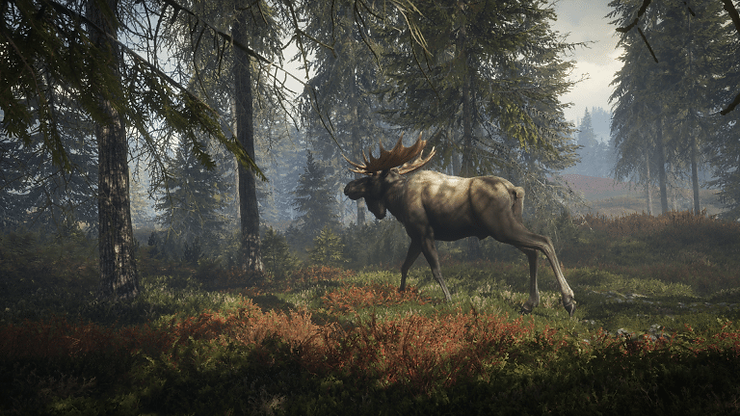
Despite knowing very little about hunting when I first came onto the project, I quickly became an expert in animal behavior across 10+ species.
It was critical to learn as much as I could about hunting and animal behavior, as theHunter franchise was created with the goal of being the “most realistic hunting games ever created.”
In fact, many fans of theHunter games are real-life hunters. This means that:
Players absolutely know when an animal behavior is off or when a species doesn’t reflect real-life.
Unlike FPS games (and arcade-style hunting games), players don’t immediately shoot everything that moves. In fact, they sometimes watch an animal (or group of animals) for a couple minutes or so, waiting for the perfect shot (or snapshot! - Some players play simply to enjoy the environments and take in-game pictures of the wildlife).
Therefore, players spend a ton of time observing the animals and their behaviors, making animal behavior a critical component in adding to the game’s believability.
An Overview: What Does an AI Designer Do Anyway?
I came onto theHunter: CotW team just as a few animals made their way into the game but didn’t yet have any behaviors. I worked with team members across different disciplines (sound designers, animators, programmers, world artists, etc.) to ensure the AI matched the expectations of actual hunters, while also meshing well with gameplay.
 I was tasked with:
Researching animal needs and behaviors.
Populating animal reserves, including:
Where species roamed, ate, slept, and drank
Designing herd size, gender composition of herds, animal schedules, etc.
Determining additional needs (such as habitats) for gameplay considerations.
Designing & implementing animal behaviors, while ensuring each species (including different deer types) were unique from each other.
A cool thing about Avalanche Studios is that their in-house engine - Apex Engine (the latest version of technology used in Mad Max and Just Cause 3) - includes proprietary behavior tree tech, allowing designers to implement AI behavior.
(The above behavior tree image is from Robert Meyer’s GDC 2017 talk on Just Cause 3’s AI Design.)
How Did AI Design Enhance the Believability of Animal Behavior?
Since the goal of theHunter franchise is to make the “most realistic hunting games ever created,” this means that a ton of research and prep work goes into creating new animal species, including all the nitty gritty details of their lives, such as:
Population - Herd size, gender composition, etc.
What does this mean to the game? Isn’t it enough to just throw in varied herd sizes and let the players have fun? - The answer is no, not at all. There are many subtleties and complexities of animal behavior that are reflected in the way animals “organize” themselves.
The following categories cover a few examples of this:
Single Gender Herds (in other words, large female herds with the occasional lurking male)
 Many deer live in single-gender herds most of the year, aside from a time period known as the rut (aka mating season). I designed animal herds to reflect these largely single-gender herds, adding in the odd male or two within the easy-to-find female herds.
Why does this matter? Since hunters typically want to bag a buck (preferably a big buck), this encourages players to stop and survey animal herds in order to find a lurking male, rather than simply skipping over large female groups. In designing these herds, it became a personal goal of mine to incorporate enough randomness among male animals so that players would be pleasantly surprised when they finally did find a higher ranking male.
(Note that I mostly refer to deer groups throughout this blog post, but in actuality, many additional species were included at launch, including the European bison, red fox, wild boar and black bear. Each species, including different deer species, involved their own, in-depth research and design process.)
Smaller Groups of Males (mostly found in dense vegetation)
Through designing the herds and their home ranges (habitats), I ensured that smaller groups of males would be found primarily in dense forest areas. This not only makes them harder to find, but the dense vegetation - combined with their keen animal ears - makes it harder to sneak close to them and get a good shot.
Highest Scoring Animals - Older Males (with keen senses, in the densest vegetation)
Animal herds and home ranges were carefully designed in order to balance difficulty with animal senses and scoring of the animal - with large herds of lower ranking animals roaming the open valleys, ranging to the individual, highest scoring males in the toughest terrain on the reserves. I’ll go into this in more detail in my next point, “Habitat.”
At this point, I want to give a shout out to Björn Öjlert - Lead Designer on the team, designer on the original theHunter game, and a fantastic mentor during my time at Avalanche Studios! His experience from the first theHunter game and knowledge of what the community wanted to see, informed a lot of the design of theHunter: Call of the Wild, as he knew which design decisions (such as animal scoring) mattered most to players and what could be improved upon to set CotW apart.