

“The greatest of these [sacrifices] was made by the scientist Karan S’Jet, who had herself permanently integrated into the colony ship as its living core. She is now Fleet Command.”
~From the introduction of Homeworld (1999)
It’s become a trope of RTS games to have a disembodied voice, usually female, act as the narrator of the game’s minutiae: “construction complete,” “our base is under attack,” et cetera. Command & Conquer, one of the archetypes of the genre, experimented with giving this voice some distinguishing traits in games like Tiberian Sun, but it remained just that: a dead voice.
Relic Games’ 1999 Homeworld, which was just recently remastered and re-released for contemporary computers, went in a completely different direction. In that game, which was a landmark for making the RTS three dimensional, that voice belonged to Fleet Command of the Mothership, a titanic colony-cum-factory ship so vast that its computer intelligence required an actual person wired into it in order to process its nearly infinite number of tasks.
Her name was Karan S’Jet.
****
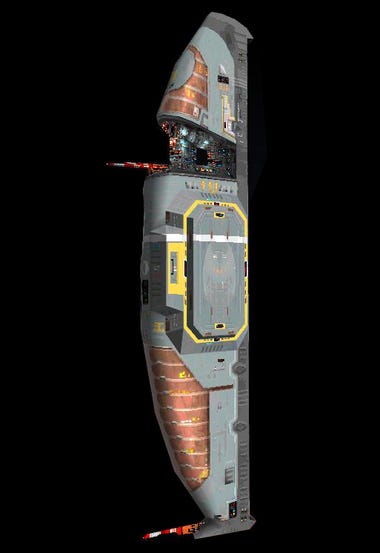 S’Jet was a neuroscientist and a leading researcher on the project that produced the mothership and the wider colonization project--a multi-generational effort by her people to discover their true homeworld and return to it. She volunteered to become Fleet Command in both Homeworld and its official sequel Homeworld 2; “it is neither duty nor obligation that drives me; it is simply what must be,” she said in that second game.
Why bring her up now? Well, in addition to the game’s re-release, and the fact that S’Jet is an incredible example of how to anchor an RTS in a genuinely compelling story (it’s not a coincidence that she is generally considered the “protagonist” of each game, collectivizing the embodiment of her people’s experience in a dramatic way), I was reminded of her by a fascinating character in Inkle’s incredible 80 Days.
80 Days is an interactive fiction game with strong RPG and resource management elements that sees you take on the role of Passepartout, valet to gambling man and wax-mustachioed international cipher of mystery Phileas Fogg, on his famous trip around the Victorian world in 80 days or fewer. The game takes many cues from Jules Verne’s original but also adapts his envelope-pushing storytelling for the 21st century by presenting a fictionalized steampunk 1872, one where the British Empire is not the only game in town and where women, non-white people, and queer folk have significant parts to play in the myriad of stories that can unfold on your journey.
The writing by Meg Jayanth claims many quiet triumphs, but one of its greatest is using the game to explore the meaning of travel to a diverse array of characters, and in the process redeeming it from the tedious slog many people perceive it to be these days. Airships, boats, and trains are not just means of conveyance; they carry the hopes of their crews. Some airships are surrogate children, others are the family home, others are a way of escaping domestic oppression, gender roles, or a parent’s depredations. In the process, as fun as Passepartout and Fogg’s wager driven journey is, your humble valet may find himself in reverential awe of the vast world of experience that travels with them on all those planes, trains, and automobiles. For so many people around the world, the ability to fly or ride on a steamer or drive a Bozek car is not motivated by a staggeringly privileged wager, but by something more primal: the need to live.
"Travel means something different for those who labor under societal disadvantages. It offers a particular, if precarious, kind of freedom. "
One of the most fascinating cases of this can be found aboard an airship between Antananarivo and Rangoon. The ship, the Maminirina, designed by the Queen of Madagascar herself, a confident and bullish technologist, seems to be missing its captain, and the fastidious Passepartout can go in search of her to please his master, who feels slighted by the lack of a personal greeting from the ship’s ranking officer. What he finds instantly brought me back to a childhood memory of Homeworld.
“I followed with some interest all the way to the engine room, where I found a most terrible sight. A woman with dark hair hung suspended amidst the pistons and gears of the engine's heart. Her body was pierced and wrapped with wires; her fingers lay carefully placed between gear-teeth. ... Dead? No. She opened her eyes, which were sheened with a strange white light, and said, "Hello, Passepartout." Her voice was full of oil-smoke and iron. "I hear you have been looking for me."”
Captain Maminirina is the Maminirina.
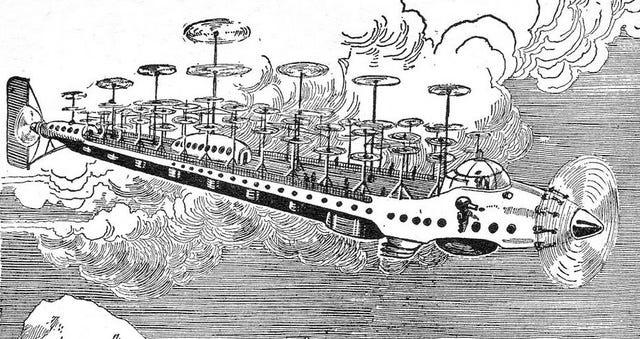
Unlike with Fleet Command/Karan S’Jet, we get to talk to her, plumb her motivations and actually see the world through her eyes.
She immediately resists being portrayed as a victim of her queen’s technological passions:
"I can feel every living body on my ship. I can feel their footfalls like little tickles, and the sun warming the timber of my hull like a warm bath. "
““Who did this to you?" I swallowed, trying not to watch the lights dancing along the wires that connected her spine to the engine.
"My Queen and her ally, Emperor Cetshwayo, made me," the captain said proudly. "I volunteered to be the first. I am the first, the first," her voice echoed like the sound of pistons.“
There can be no doubt she wanted this, and you quickly learn why. The airship has become her body, her old corporeal form now merely the heart and mind of something much more vast, and unlike Karan S’Jet she cannot free herself. Unlike Karan S’Jet she would never want to. "I can feel every living body on my ship. I can feel their footfalls like little tickles, and the sun warming the timber of my hull like a warm bath. I can taste the air pressure like wine and the steam boiler powering my body like a white-hot heart. My sails touch the sky like a lover's caress… Oh Passepartout, I am so powerful. So beautiful. You could never understand."
There is an old Aeschylus quote, "Bronze [is] the mirror of the form; the wine of the mind" whose meaning is clarified in the penumbra of Maminirina's experience, one where raw minerals enflame and intoxicate your very veins. That is travel, fully embraced.
Pa
No tags.