

Selling the player on the fiction of your game can be a difficult thing. There’s a healthy amount of benefit of the doubt, with the player’s mind vaulting the hurdles required to convert WASD into ambulation, or the click of a mouse into the pull of a trigger.
But still, there’s a disconnect present between the player’s experience and that of their avatar. Nathan Drake might leap a dozen feet across a sandswept ruin, but you’re just vicariously perched over his right shoulder, watching it unfold. Thrilling, yes, but pretty far from the actuality of it.
What you are doing--if you’re on a PC--is sitting at a desk and interacting with a screen with a keyboard. Not the most exciting of positions, but one that can be leveraged by a game designer for a specific kind of game, putting the player close to the fiction of the game, rather than disconnected from it. As Tim Keenan, developer of Duskers, puts it, “Every PC player is on a computer, so how can you use that fact?”
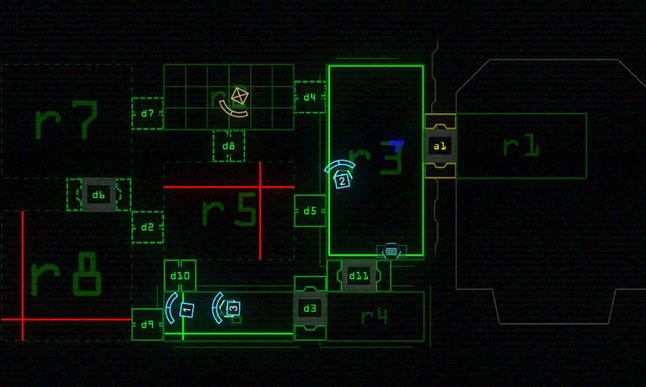
Duskers does it by making you a drone operator exploring abandoned space ships from your isolated terminal. Using command-line prompts and a very incomplete view of the proceedings, you selectively power parts of the derelicts to strip them of useful materials, all the while avoiding enemies that are as indistinct as they are terrifying.
More often than not, they’re simply a red reticule moving spasmodically around a room that you keep safely locked, like a trapped and very angry insect. It's minimalistic, but that alone is enough to create a constant state of dread, knowing that if you open the wrong door your drones could end up like the very obviously deceased crew of whatever ship you’re exploring.
“We give you less information, and make it harder to perceive, and that makes the player more uncomfortable,” Keenan continues. “The camera is also too close, which gives you a sensation of claustrophobia. All of these things make it so you can’t get a clear picture of things, enabling the player’s imagination to run wild.”
Leveraging what you already have
"All of these things make it so you can't get a clear picture of things, enabling the player's imagination to run wild."
A screen and keyboard only allow you so much interaction. This is true of Her Story, another game in which your screen is the game’s screen, a terminal representing a terminal. You can only watch the entries of its murder mystery using its limited search function, and you can’t help but feel the intentional obfuscation between you and the fiction of the world. However instead of feeling frustrating and limited, it instead pulls yo into the game world that much more, as there's no UI trying to bridge the gap between you and the actions of the world. You point, and you click, and it behaves exactly as you'd expect.
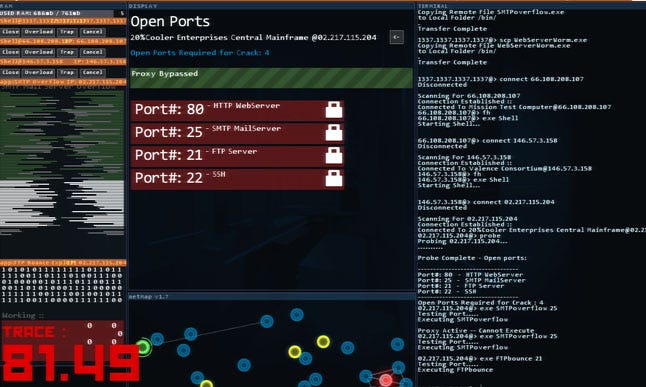
Another example is the recently released Hacknet, a game which takes the ideas of Introversion’s Uplink and runs wild with them, putting you in the role of a hacker in the world of pervasive technology and apps, jumping from a person’s personal computer to their tablet to their smart phone. It’s like seeing people’s lives from backstage, with all the wiring exposed.
“I was always reinforcing the idea that the player is the one making decisions,” Matt Trobbiani of Team Fractal Alligator, who made Hacknet, tells me. “There’s no avatar separating them from their actions.” The result of this is a sense of detachment that strongly divorces you from the proceedings of the game, as you edit death certificates, company records and medical documents. “I tried to abuse this detachment with a few moments that would ‘remind’ the player of the humans and reality that this data represents, and have them reflect on their actions and detachment.”
Something that ties all three of these games together is a sense of verisimilitude, an old idea in the literary and cinematic mediums, but one that is less pervasive within games. The idea being to use the medium itself as a strength. Turn a novel into a diary, the film into a found recording of events that are presented as ‘real’, even though we, as the audience, know that they’re fiction. By positioning the audience, or the player, that much closer to the fiction their suspension of disbelief is that much less tested.
The advantages of less
"The more you don't see, the more you dread it. We don't even have proper animation for the enemies."
The flip side of this, however, is that you’re then afforded more space to maneuver when it comes to creating an atmosphere or hitting the player with an emotional payoff. In Duskers, the horror elements are a much easier sell because you rarely, if ever, actually have contact with the enemies, instead attempting to quarantine them in parts of the ship you don’t need to visit or can afford not to. The drone’s view itself is also fuzzy and indistinct, shapes hinting at a few different things rather than anything specific.
“The more you don’t see, the more you dread it.” Keenan elaborates. “We don’t even have proper animation for the enemies. We just have them move and twitch, and it’s amazing to see how many people when I watch them play on stream, as soon as they see that red reticule come up, meaning that the drone has identified a threat, that’s enough to freak them out.”
Her Story is extremely economic with its assets, too, with only the terminal interface and the real footage of each snippet making up the entire game. Hacknet only needs to present you with a few icons, a command line interface and occasionally a bit of art for one of its fake websites. But what it’s able to achieve with this is quite astonishing, especially at one particular moment (that is a large spoiler for the game).
“For a long time before even touching the code I was debating if it had a place in the game,” Trobbiani tells me when I ask him about the specific instance, where an optional job comes up to hack into a man’s pacemaker. “If it would work, if I could build the gravity of the situation so it wasn’t trivial, if it was even thematically appropriate. I read an article on games a long time ago that discussed the idea of taking a life as a powerful, intensely personal, traumatic experience, and how games trivialize that. It had some really interesting ideas – around the idea of pulling a trigger in a game being something disturbing and unforgettable.”
Creating emotional impact out of minimal assets
“I want to some lengths to design the monitor UI in a realistic way.” Trobbiani continues. “The code behind it was really interesting to develop – the Hacknet UI is essentially a functional heart monitor, that just accepts inputs from a simulated organ – it was designed so that I could plug in real, live data, and it should look very similar – ideally even be useful in a hospital situation.
No tags.