
Amid the trend toward premiumization, a major challenge has emerged: how to enhance game quality while maintaining the low-performance consumption and instant-play characteristics of mini-games. To better port mini-games, Unity has introduced WebGL and WebAssembly technologies.
WebGL is a JavaScript API that enables 3D graphics rendering within browsers. WebAssembly (Wasm), meanwhile, is a new code format that allows high-performance compiled code to run safely and efficiently within a browser's sandboxed environment.
Compared to JavaScript, adopting the Wasm solution can better reproduce high-quality visuals while minimizing the impact on startup performance efficiency.

As quality improves and technology evolves, security challenges become increasingly severe. We have observed frequent security incidents targeting mini-games, primarily involving reverse engineering of the global-metadata.dat file within these games.
In Unity's IL2CPP mode, game logic runs as native code. However, certain C# language features (such as GC and reflection) persist. These features log all C# class names, property names, strings, and other information into the global-metadata.dat file. When IL2CPP starts, it reads the required information from this file.
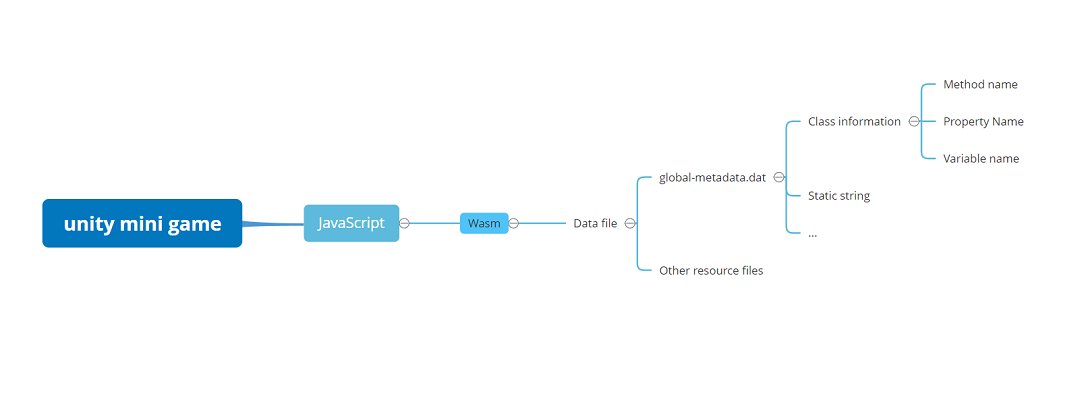
It is precisely this mechanism that provides a breakthrough for cracking and creating Cheats. Hackers will parse data files to extract the global-metadata.dat file, then perform reverse engineering analysis. Subsequently, the parsed dump.cs file can be dragged into a parsing tool to directly analyze the source code:

This leaves mini-games completely exposed to crackers. They can directly plagiarize and steal the source code, copy competitors' games to launch quickly, or analyze data to create and sell cheats, severely impacting the player experience.
JikGuard mini-game and H5 hardening solutions now support Unity code encryption. This effectively combats reverse engineering and code plagiarism, safeguarding mini-game security with the following features:
■ Mini-Game Code Protection
Compatible with Unity Wasm code, this solution provides comprehensive protection for global-metadata.dat within mini-games, including code encryption, anti-debugging, and tamper-proofing. It employs a binary non-script implementation for enhanced efficiency and security.
■ Mini-Game AssetBundle Resource Encryption
Unlike other mini-game hardening solutions on the market that merely obfuscate JavaScript code, JikGuard has developed an encryption method highly integrated with game engines:
It adapts different resource encryption approaches for various game engines, maximizing protection for in-game assets such as images, audio, and video.
■ Mini-Game Communication Protocol Protection
JikGuard provides communication protocol protection and data verification for mini-games, enabling precise validation of both upload and download data. This effectively prevents protocol hacks and safeguards against game tampering.
■ Intellectual Property Protection for Mini-Games
JikGuard provides image watermarking and steganography for in-game art assets, offering robust support and protection against infringement and unauthorized use.
Additionally, JikGuard's mini-game hardening solution achieves zero integration cost with automated configuration: no SDK integration required, no complex settings needed. Simply set a gamekey and run a single command line to complete hardening within 30 seconds—without generating redundant package sizes.