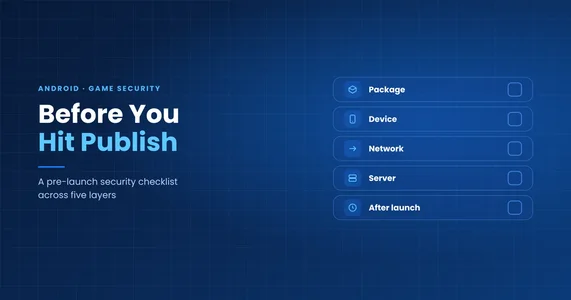
Before You Hit Publish: A Pre-Launch Security Checklist for Android Games
Most launch-day security gaps fall between teams. A checklist for Android games, organized by where attacks actually happen, from the APK to the server.
Read article
Technical articles on Android game security, client integrity, game engines, and the threats developers need to understand.
Most launch-day security gaps fall between teams. A checklist for Android games, organized by where attacks actually happen, from the APK to the server.
Read article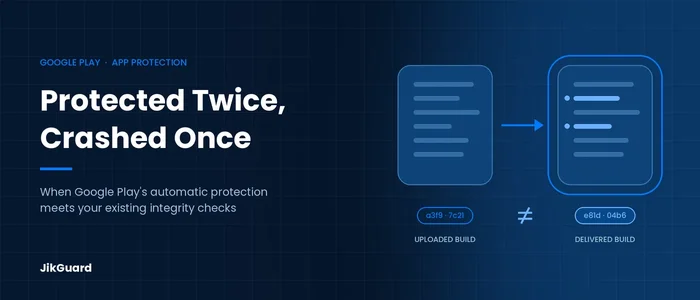
Google Play’s automatic protection modifies your app after upload. If your build already checks its own integrity or signature, those checks can stop the game at launch. Why it happens, and how to diagnose and fix it.
Read article
Google released Android 17 QPR2 Beta 3 on August 14. As Android 17 adoption expands across devices and system builds, game studios need to revalidate how protected clients, third-party SDKs, and native libraries behave under the latest platform rules.
Read article
In gaming security, a “risk environment” is any setup that runs independently of the original device or that compromises the device’s native system. The usual suspects: cloud phones, virtual machines, virtual frameworks, jailbroken iOS devices, and rooted Android devices.
Read article
According to JikGuard’s own data, memory modification accounts for roughly 11% of the security threats games face. The attack itself is simple in principle: gain elevated privileges, then point a memory editor at the game and rewrite its values on the fly.
Read article
Root permissions, i.e. super user permissions, in Android system, obtaining root permissions means that users can modify system files, remove pre-installed apps, install special apps and so on.
Read article
Game applications rely primarily on devices to obtain location information, which creates ample opportunities for fraud within the Game Black/Gray Industry. Across different mobile operating systems, the methods for implementing Fake Location spoofing are highly diverse.
Read article
With its excellent open source ecosystem, Android has become the leader in mobile phone systems. According to a report by research firm Canalys, Android devices account for 78% of the overall market share.
Read article
Observations indicate that in recent years, attacks from the Game Black/Gray Industry have shown a significant trend toward diversification in their approaches. Key security challenges include studio operations, custom injection hacks, auto click hacks, memory modification hacks, and Hack versions.
Read article
An emulator is software that simulates an Android mobile operating system on a PC. It not only saves storage space on your phone and prevents overheating from prolonged gaming sessions but also allows you to control games using a keyboard and mouse. In certain gaming scenarios, this enhances the player's overall experience.
Read article
AssetStudio is a commonly used resource extraction tool. This article analyses how games should address hacking issues through case studies and proposes effective solutions.
Read article
In this article, we will analyse the features and principles of the reverse engineering tool ‘MT Manager’ through case studies and provide solutions for game hacking.
Read article
The Android Developers Blog announced that, starting from 1 November 2025, all app updates submitted to Google Play targeting Android 15 and higher must support a 16 KB page size on 64-bit devices. Applications that have not been adapted to this new specification may face the risk of not running properly in the future.
Read article
JikGuard conducted an in-depth analysis of the Unity Resources resource loading principle, found the core points of encryption and decryption, and constructed a solution and algorithm for random encryption of resources.
Read article
Although the open source ecosystem has brought Android better development space, it has also brought with it a lower threshold for hacking and more serious security issues. A common method of cheating in Android games is to obtain root privileges to provide an environment for game cheats and hacks.
Read article
Risky environments for games are environments that are independent of the original device or disrupt the original system of the device. Common game risk environments include: iOS jailbreak, Android root, virtual machines, virtual frameworks, cloud phones and so on. Because these types of risky environments can provide the high-level device permissions needed for game cheats and hacks, there are often greater security risks when the game is in these device environments.
Read article
In recent years, the game market has been developing at a high speed, and along with it, there are also game black and grey industry that seek to make profits. Driven by profit, the scale of game black and grey industry is expanding rapidly, and the attack trend shows the characteristics of diversified angles. Under this trend, the detection coverage of game security protection is particularly important. If the game protection is missed in a certain part of the inspection, in a short period of time, the game cheats will complete the iteration, which will lead to the failure of …
Read article
In this paper, we will analyse the implementation principle and detection difficulties of cloud mobile phone and provide detection solutions through case studies.
Read article
Although the open source ecology has brought Android a better space for development, there are also certain security problems. In terms of game security, the Android side of a game is relatively lower threshold for hacking and making cheats, and faces more serious security problems.
Read article