Key takeaways
- AI tools that help developers write code are also helping attackers read it. Agents can now drive disassemblers like Ghidra and IDA.
- Work that used to need deep reverse-engineering experience is getting faster and easier to start, which means more cracks, mods and cheats, sooner.
- AI analysis works best on readable code, clear names and plain strings. Protection that removes those clues raises the cost again.
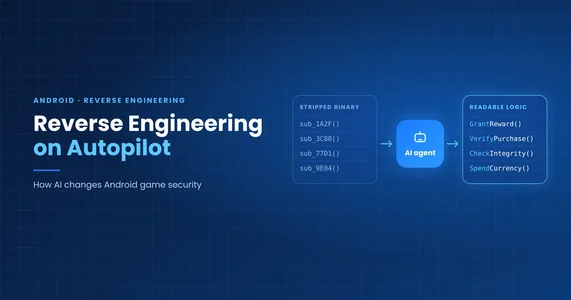
Does AI make it easier to reverse engineer games? Yes. Large language models connected to tools like Ghidra and IDA can now do much of the tedious work of reading a binary. For Android games, that means less skill is needed to find reward logic, purchase checks and anti-tamper code.
How are game developers using AI?
AI is now a normal part of making games. In the 2026 Unity Game Development Report, 62% of surveyed developers said they use AI tools for coding assistance.
A model that can explain your own function so you can finish it faster can just as easily explain someone else's function so they can change it.
How did reverse engineering a game work before AI?
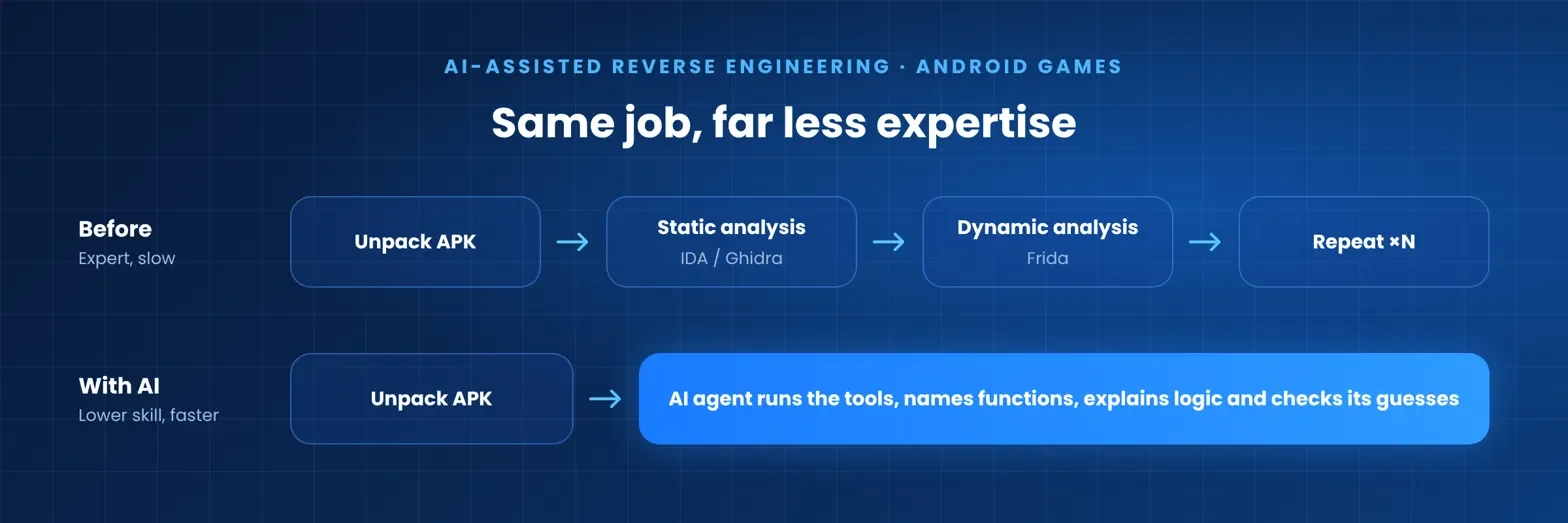
Cracking a game client used to be slow, specialist work. An attacker would:
- Unpack the APK and strip any packing or obfuscation.
- Load the binaries into a disassembler such as IDA or Ghidra for static analysis.
- Attach tools such as Frida to watch the game while it runs.
- Repeat, round after round, until the key logic made sense.
Each step took time and experience. For most casual cheaters, that was where it ended.
What changes when AI joins the process?
With large language models in the loop, much of that process is becoming automated.
Open-source projects now connect coding agents such as Claude Code and Codex to Ghidra, IDA and Hopper through MCP servers. The agent can open a binary, inspect functions and cross-references, and test its own guesses. One of these projects, Reverse Engineer Anything, has drawn wide attention. InfoQ's coverage of the project noted that some independent developers worry AI-assisted reverse engineering will make it easier to copy their games and bypass paid features.
There are already plenty of examples. A security researcher published notes on pointing an AI agent at a game's libil2cpp.so; it worked out that the encryption was a simple repeating XOR. Hobbyists have written up using Claude with Ghidra to take apart classic Atari and Apple II games. On reverse-engineering forums, people with little experience describe using AI to recover how paid software checks a license, or to modify and repackage an APK so a game hands out different rewards.
What does this mean for Android games?
For a live game, the practical effect is time. The gap between a release and a modded APK with unlocked purchases gets shorter, and the people producing those mods no longer have to be experienced reverse engineers. Patches help less too: if analysis is cheap, a cheat maker can go through each new build again without much effort.
How do you protect a game against AI-assisted analysis?
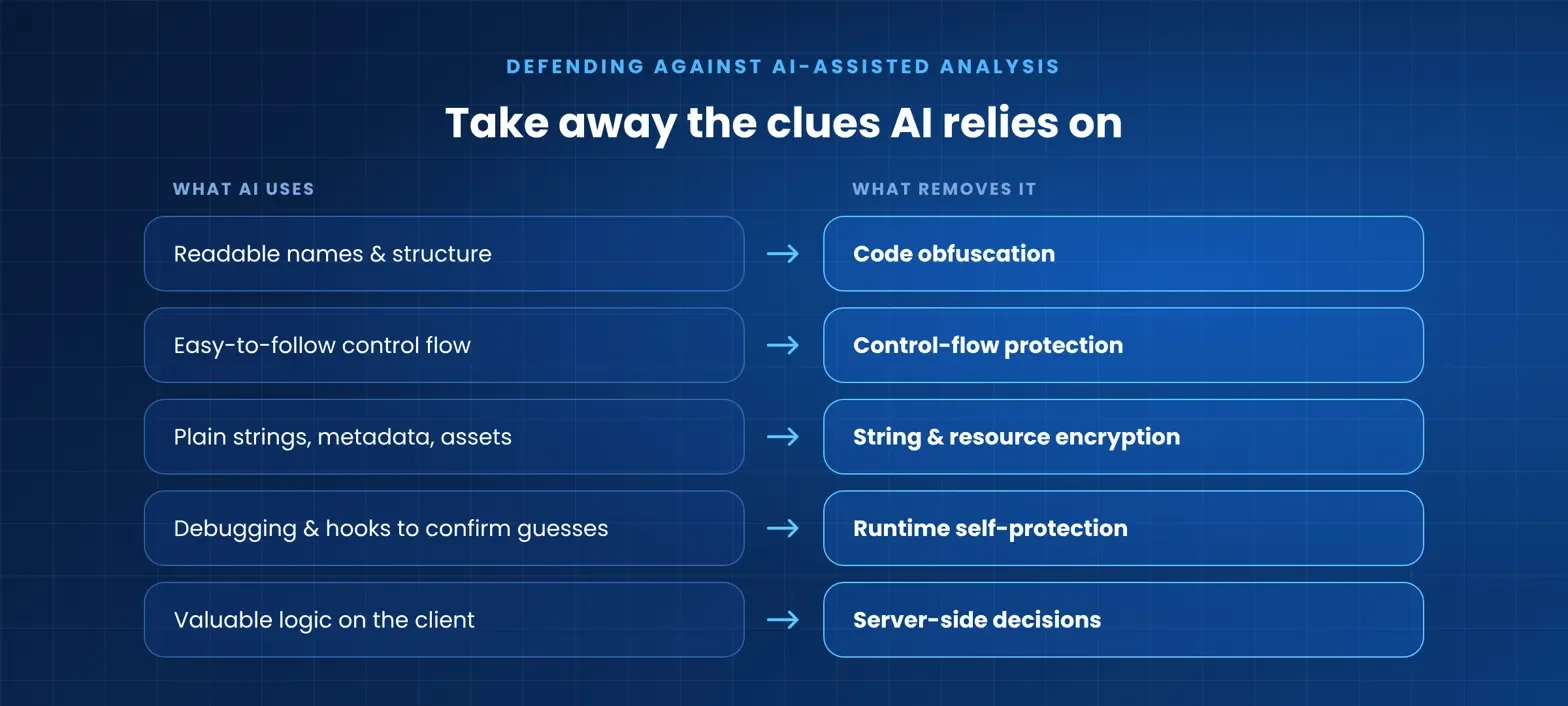
An AI agent can only work with what it can read. The less useful information your build gives away, the less it has to go on:
- Code obfuscation. Meaningful names and readable structure are exactly what a model uses to guess intent. Obfuscated code gives it far less to work with.
- Control-flow protection. Flattened or disguised control flow makes it harder to follow what a function actually does.
- String and resource protection. Plain strings, unprotected metadata and readable asset files are easy entry points. Encrypting them removes the shortcuts.
- Runtime self-protection. Static analysis is only half the job. Detecting debuggers, hooks and tampering makes it harder to confirm what the analysis found.
- Keeping critical logic off the client. Reward calculations, purchase verification and anything worth faking should be decided on the server.
No single layer stops a determined attacker. The goal is to make analysis slow and unreliable enough that it stops being worth it. For a full list of what to review before shipping, see our pre-launch security checklist for Android games.
Where JikGuard fits in
JikGuard protects Android games built with Unity, Cocos and Unreal Engine. Protection is applied to your APK or AAB at build time and covers supported code, native libraries, engine metadata (including Unity global-metadata files where applicable) and packaged resources such as AssetBundles. At runtime, it helps raise the cost of common tampering, memory modification, hooking and play in high-risk environments. Your signing keys stay with your team.
Client-side protection should sit alongside server-side validation, not replace it.
FAQ
Can AI decompile a game?
It works through decompilers rather than replacing them. An AI agent connected to Ghidra or IDA can read the output, rename functions and describe what the code does, which speeds up analysis considerably.
Are Unity IL2CPP games safe from AI reverse engineering?
No. IL2CPP compiles C# to native code, but metadata and native libraries can still be analyzed, and AI tools have been used on libil2cpp.so directly. Dedicated tools are improving too, as we covered in Pieced Back Together: How Cpp2IL Rebuilds Protected Unity Metadata. IL2CPP builds still need their code, metadata and resources protected.
What makes AI-assisted analysis harder?
Removing the clues it depends on: obfuscated code and control flow, encrypted strings and resources, runtime checks against debugging and hooking, and keeping important decisions on the server.
Summary
The attacks are the same ones game teams have dealt with for years. What has changed is how quickly someone with an AI agent can carry them out, and how little experience they need. That makes client protection, and keeping important decisions on the server, worth a closer look for more games than before.
To see what JikGuard covers, explore Game code & asset protection and Anti-cheat & anti-hack, or start with the Docs.